All About Echinoderms
Sea stars, sea urchins and allies - navigating the ocean floor with spines, arms, and tube feet!
What Are Echinoderms?
Echinoderms are invertebrates that exclusively inhabit oceans. This group includes sea stars, sea urchins, and sea cucumbers, with over 6,300 species found worldwide. Most of them reside on the ocean floor.
Main Characteristics of Echinoderms
1. Beware of Their Spines!
Echinoderms possess a calcium skeleton beneath their skin. Often, spines or thorns grow from this skeleton, helping them fend off predators. Sea stars and sea cucumbers typically have short spines, while sea urchins can have very long ones. For instance, the black sea urchin can have spines that reach up to 12 inches (30 cm) in length.
2. Arms Everywhere!
Most sea stars have five arms, but some species have many more. The sun star, for example, has 15 arms, while the Arctic sun star (Labidiaster annulatus) can have as many as 40-45 arms. Sea urchins and sea cucumbers do not have arms.
3. Tube Feet
All echinoderms have tube feet made of soft tissue. These are very sensitive and allow echinoderms to sense their surroundings. They also assist in movement, enabling them to walk, climb, and cling to rocks, corals, or shells.
Echinoderm Family Tree
Amazing Facts About Echinoderms
- There are 6,300 species of echinoderms.
- Echinoderms include starfish, brittle stars, feather stars, sea lilies, sea urchins, and sea cucumbers.
- Echinoderms can only be found in the ocean. Most of them inhabit shallow waters on the sea floor.
- Echinoderm originates from Ancient Greek. The term "ekhînos" means "hedgehog" (which is a spiny animal) and "dérma" translates to "skin". In fact, there are spines or thorns on their body.
- Echinoderms lack the traditional brain structure. Instead, they possess a sophisticated nervous system that enables them to make decisions and control their movements.
- Echinoderms can be either herbivores or carnivores. Sea urchins are mostly herbivores, feeding on algae. Starfish are often carnivores, consuming clams and other marine creatures.
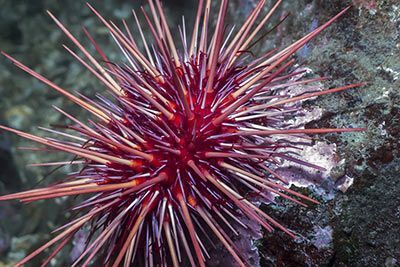
- The largest sea urchin is the red urchin. It can reach a diameter of 7 inches (18 cm).
- Sea urchins can live for a very long time. The red urchin can even reach over 100 years of age, and some say it can live up to 200 years.
- The flower urchin is the most dangerous type of sea urchin. A touch can lead to not just intense pain, but also breathing difficulties, muscle paralysis, numbness, and confusion. This can result in drowning for divers and snorkelers. This creature inhabits the Indo-Pacific region.
- The heaviest starfish is Thromidia gigas, which can weigh up to 13 pounds (5.9 kg). The largest starfish is Midgarida xandaros, with a diameter of up to 4.5 feet (1.38 meters).
- The crown-of-thorns starfish reproduces rapidly and can cause significant damage by eating corals, which leads to the destruction of reefs. It is also dangerous to humans due to its venomous spines.
- The largest sea cucumber is the snake sea cucumber. It can grow to be 6.5-9.8 feet (2-3 meters) long.
Species List
Sea Urchin
Written by Silke Menne.
Starfish
Written by Silke Menne.