animalfunfacts.net - The Animal Encyclopedia for Kids

ADVERTISEMENT

Top 15 Weirdest Animals in the World

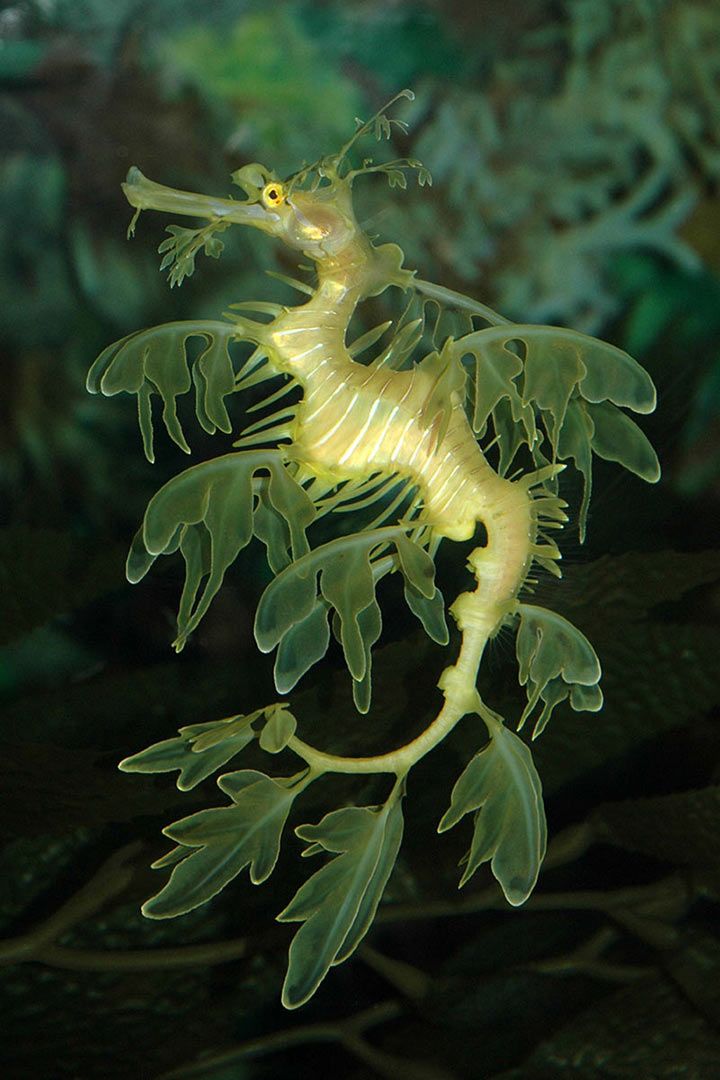
#14 Leafy Seadragon (Phycodurus eques / Phyllopteryx taeniolatus)

Leafy Seadragon - Photo: Jacqueline Lee/Shutterstock

Facts

  • Class: Fish
  • Order: Syngnathiformes
  • Family: Syngnathidae
  • Distribution: Australia
  • Habitat: Costals water up to 164 feet (50 meters) deep

A Floating Bush: The Masters of Plant Camouflage

If you go diving in the shallow coastal waters of Australia, you might just miss one of the strangest creatures in the world swimming right in front of you! The Leafy Seadragon is a close relative of the well-known seahorses. It gets its name from a brilliant invention of nature: its entire body is covered with countless, skin-like appendages that perfectly resemble the leaves of brown algae or kelp.


ADVERTISEMENT - ARTICLE CONTINUES BELOW

There are two main species of this creature: the Large Leafy Seadragon (also known as the “Frilled Leafy Seadragon”), which is completely adorned with these leaf-like “frills,” and the somewhat simpler Small Leafy Seadragon, whose protrusions look more like slender grasses. In biology, this perfect imitation of plants is referred to as mimesis.

How Does this Fish Move?

The skin-like flaps on its body are solely for visual deception. The fish cannot use them as fins for swimming or for steering. To navigate through the water, the ragfish has tiny, almost completely transparent dorsal and pectoral fins. These fins beat so rapidly that they are barely visible to the naked eye.

This allows the fish to glide forward in an extremely slow and majestic manner. To predators like larger carnivorous fish or seabirds, it simply appears as a harmless, detached piece of seaweed drifting leisurely with the ocean current. The ragfish can even move its eyes independently to scan its surroundings for threats without moving its perfectly camouflaged body.

The Invisible Hunter with the Straw

The camouflage not only protects the ragfish from predators but also aids in its own hunting. It primarily feeds on tiny crustaceans (like delicate brine shrimp). Lacking teeth, it has developed a different strategy.

Disguised as an "underwater bush," it approaches unsuspecting crustaceans very closely. Once it is near enough, it opens its long, tube-shaped mouth wide. The sudden drop in pressure creates a strong suction – and the prey is quickly drawn in like through a straw.


ADVERTISEMENT - ARTICLE CONTINUES BELOW

Interestingly, just like seahorses, the ragfish's family planning is the responsibility of the males: The female transfers the eggs to the male after mating. He attaches the brood under his tail and carries the eggs around for several weeks until the tiny, perfectly camouflaged babies hatch.

Next up at position 15: The absolute king of camouflage on land!

The ragfish perfectly disguises itself as an underwater plant – but our position 15 takes it a step further on land! We travel to the dense rainforests of Madagascar to meet a lizard that not only resembles a dry, brown leaf but also mimics the fine leaf veins and nibbled holes. Click now to meet the fascinating leaf-tailed gecko!


ADVERTISEMENT - ARTICLE CONTINUES BELOW