Top 15 Weirdest Animals in the World
#9 Clearwing Moth (Greta oto)
Facts
- Class: Insects
- Order: Butterflies
- Family: Nymphalidae
- Distribution: Central to South America (Mexiko to Venezuela)
- Habitat: Tropcial rainforests
I spy with my little eye...: Butterfly with built-in window panes
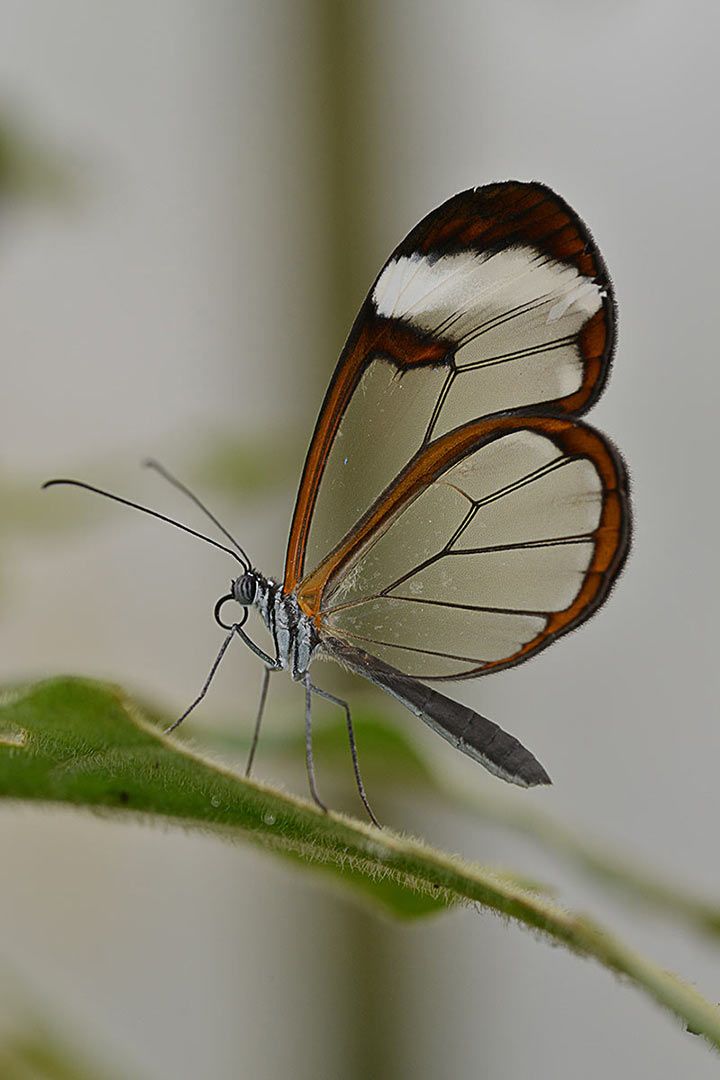
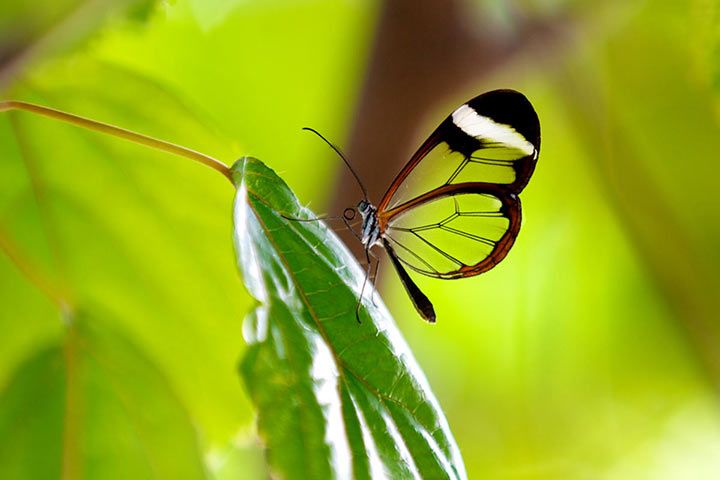
Most butterflies captivate us with their stunning, vibrant colors. However, the Glasswing (especially the species Greta oto) takes a completely different approach: it relies on total invisibility! Its large wings feature only a narrow, dark brown edge. The areas in between are entirely transparent – just like small, delicate window panes.
Typically, butterfly wings are covered in thousands of tiny scales that lie side by side like roof tiles, giving the butterfly its color. In the case of the Glasswing, these color scales are almost entirely absent in the inner sections of the wings. What remains is a thin, crystal-clear membrane (skin) through which the surroundings can be seen in sharp detail.
The Invisibility Trick Against Hungry Birds
But who is supposed to see through it and why? Of course, its enemies! In the dense, shady rainforest, the glasswing butterfly is nearly invisible to birds or lizards while in flight. Since it doesn’t emit any bright signal colors, it blends seamlessly with any background it lands on. This provides it with excellent protection from the sharp beak of a hungry predator.
The craziest part: Even when the sun shines directly on the butterfly, its wings hardly reflect any light. Researchers have discovered that the surface of the wings is covered with tiny, irregular structures at the nanometer scale (millionths of a millimeter!). These act like a perfect anti-reflective coating, similar to modern eyeglass lenses or smartphone screens. The light isn’t reflected back; it simply passes straight through the wing.
Toxic Snack: Beware, inedible!
If a bird manages to catch the invisible flyer, the next surprise awaits: The butterfly tastes incredibly bitter and is poisonous! Even as a small caterpillar, the glasswing feeds solely on the leaves of nightshade plants. These plants contain potent toxins. The caterpillar stores the poison in its body and carries it into its life as a butterfly. Birds quickly remember this unpleasant taste and prefer to leave the glasswing alone next time.
At the tropical butterfly house in Maximilianpark in Hamm (Germany), I had the chance to admire a glasswing butterfly and, of course, I snapped a photo for you :)
Silke from animalfunfacts.net
On to place 10: A deer in a vampire costume!
On the next page, we encounter an animal that makes you do a double-take. It looks like a small, adorable deer – but two long, razor-sharp vampire fangs protrude from its mouth! Has Count Dracula had a hand in this? Click ahead now to discover the mysterious musk deer!
Souces:
- The role of random nanostructures for the omnidirectional anti-reflection properties of the glasswing butterfly (https://pubmed.ncbi.nlm.nih.gov)
- Nature: Reflexionsarme Flügel machen Schmetterlinge fast unsichtbar (https://www.kit.edu)
- Table of Contents:
- 0. Introduction
- 1. Longhorn Cowfish
- 2. Glass Frog
- 3. Sawfish
- 4. Fried Egg Jellyfish
- 5. Streaked Tenrec
- 6. Red-Lipped Batfish
- 7. Saiga
- 8. Spook Fish
- 9. Clearwing Moth
- 10. Musk Deer
- 11. Dugong
- 12. Blue Ocean Slug
- 13. Giant Isopod
- 14. Leafy Seadragon
- 15. Leaf-Tailed Gecko