animalfunfacts.net - The Animal Encyclopedia for Kids

ADVERTISEMENT

Quokka

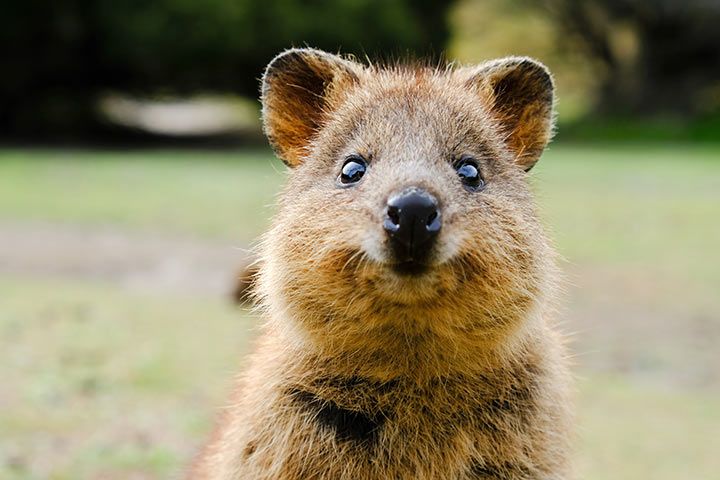
Quokka Photo: Gone For A Drive/Shutterstock

Quokka Facts

Size 16-21 inches (40-55 cm)
Speed Up to 18 mph (30 km/h)
Weight 5.5-11 pounds (2-5 kg)
Lifespan 10-15 years
Food Grass, leaves, herbs, plants, fruit
Predators Cats, foxes, dogs, dingoes
Habitat Australia
Order Diprotodontia
Family Kangaroos
Scientific name Setonix brachyurus
Characteristics Small kangaroo that seems to smile all day long

Main Characteristics

Quokkas are small kangaroos often referred to as the "happiest animals on Earth". Their mouths curve upwards, and when they open their mouths, it appears as if they are joyfully smiling or grinning. Quokkas are quite social and tend to form groups ranging from 25 to 150 individuals.

Name

Quokka is pronounced like "kwo-kuh". The name is indeed peculiar, so where does it originate? It is a variation of the word "gwaga" or "kwaka", which comes from the language of the Aborigines (the indigenous people of Australia). The exact meaning remains unknown.


ADVERTISEMENT - ARTICLE CONTINUES BELOW

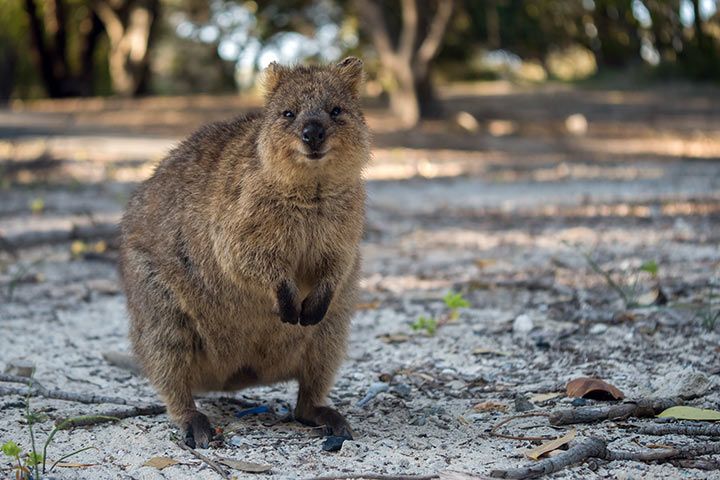
Funny Quokka Funny Quokka - Photo: David Haykazyan/Shutterstock

Distribution and Habitat

Quokkas are found in Australia, primarily on Rottnest Island and Bald Island. They prefer habitats like bushland and grassland with thick undergrowth. In open, dry areas, they only stay if there is enough fresh water, shade, and vegetation available. On the mainland, they also inhabit swamps and forests.

Way of Life

Quokkas are nocturnal because it gets too hot for them during the day. Instead, they prefer to sleep in a protected, shady spot. They are not solitary creatures; rather, they live in groups of 25 to 150 animals.

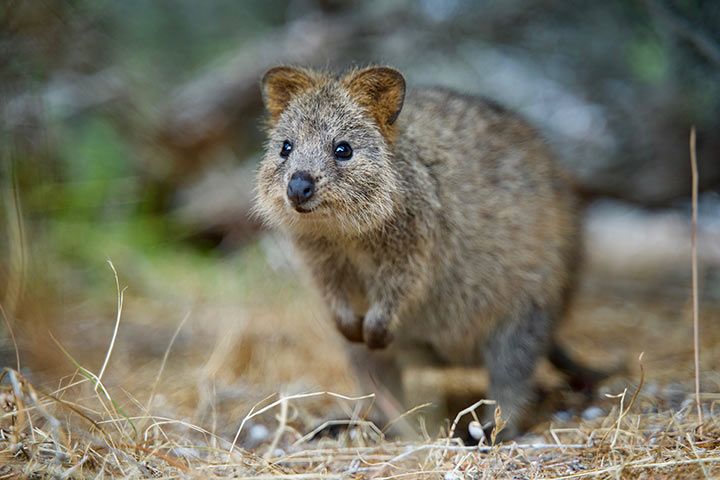
Funny Quokka Funny Quokka - Photo: Emanuele/stock.adobe.com

Anatomy and Appearance

Size and Weight

A quokka is roughly the size and weight of a domestic cat. Its body length is 16-21 inches (40-55 cm), and its tail measures 9.8-12 inches (25-30 cm) long. The weight of a quokka is between 5.5 and 11 pounds (2-5 kg).


ADVERTISEMENT - ARTICLE CONTINUES BELOW

Tail

Quokkas, unlike other kangaroos, have a very short and smooth tail. They cannot use it for support – but that's not necessary at all. They need it to maintain balance while hopping.

Ears

Quokkas have small, round, upright ears.

Fur

Quokkas have a coarse, gray-brown fur with a subtle reddish sheen.

Quokka or Wallaby – What's the Difference? Quokka or Wallaby – What's the Difference? - Photo: Susan Flashman (left), Dennis Jacobsen (right)/Shutterstock


ADVERTISEMENT - ARTICLE CONTINUES BELOW

Quokka or Wallaby – What's the Difference?

Quokkas and wallabies are both gray-brown marsupials that inhabit Australia. Although they are closely related, they belong to two distinct genera. They can be easily distinguished by their appearance: most wallabies are larger, possess a longer tail, have pointier ears, and a longer face compared to quokkas.

Quokka or Wombat – What's the Difference? Quokka or Wombat – What's the Difference? - Photo: altfotokunst (left)/stock.adobe.com, Mari_May (right)/Shutterstock

Quokka or Wombat – What's the Difference?

Quokkas and wombats are both gray-brown marsupials found in Australia. They both have short noses and small ears. However, wombats are not part of the kangaroo family. Unlike quokkas, they possess a short tail and are unable to hop. They move around on all fours. Additionally, they dig burrows where they can retreat and sleep.

Diet

Quokkas are herbivores. They primarily feed on grasses, leaves, and plants. One particular plant they adore is the mallow species known as Guichenotia ledifolia. Its flowers come in shades of blue, purple, or pink. When quokkas have enough leaves to munch on, they can survive for extended periods without water.

Cute Quokka Cute Quokka - Photo: DashaBar/Shutterstock

Behavior

Behavior in Case of Danger

• Escaping via Paths

When in danger, quokkas try to run away. They are well-prepared for their escape: while foraging for food, they trample down tall grass, creating a network of "tunnels". They use these to quickly evade threats. On the flattened paths, they move much faster and remain unseen by predators.

• Leaving the Young Behind

If a quokka has a joey in its pouch and finds itself in a tight spot, it will place its young on the ground and hop away. The joey starts to call out, drawing the attention of the attacker. While this may seem cruel, it ensures the mother's survival. She can have another baby at a later time. Otherwise, neither the mother nor the baby would survive.

Are Quokkas Dangerous?

Wait a minute? The happiest animals in the world are supposed to be dangerous? It's true that quokkas are very peaceful and relaxed, but even that has its limits. For instance, when they are pressured by humans. Especially by tourists wanting a shared photo. They can scratch with their sharp claws, they can bite, and they can kick with their strong hind legs. Every year, people end up in the hospital because they were injured by a quokka. But that's only because they provoked the quokka.

Quokka Quokka - Photo: DaniiGrylls/Shutterstock

Senses and Abilities

Climbing

Can quokkas climb? Yes, to reach fruits, quokkas can climb trees that are up to 5 feet (1.5 meters) high.

Life Expectancy

Quokkas can live for around 10-15 years.

Enemies and Threats

Natural Enemies

The natural enemies of quokkas primarily include introduced red foxes and dingoes. Additionally, free-roaming cats and unrestrained dogs are responsible for fatal injuries. Originally, their only predators were birds of prey and snakes.

Human Impact

Quokkas are suffering from habitat loss. They prefer bush and grassland environments. However, introduced predators like red foxes and dingoes are causing them to increasingly inhabit dense forests on the mainland, where they find more protection. On Rottnest Island, where they are most commonly found, there are no foxes, but there is also not always enough fresh water.

Conservation Status

According to the IUCN, quokkas are classified as a vulnerable species. They were once very common on the Australian mainland, but their numbers have significantly declined due to the introduction of species like foxes and cats. An estimate from 2024 suggests that there are still about 7,500 to 20,000 adult individuals.

Importance for the Ecosystem

Quokkas feed on grasses and leaves. Through their droppings, they spread seeds that can grow into new plants. While grazing, they also help maintain a balanced variety of different plants.

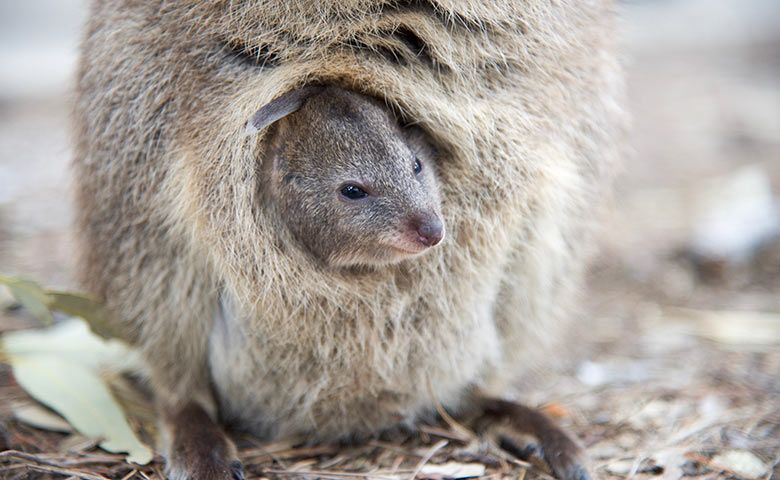
Quokka With a Baby in Its Pouch Quokka With a Baby in Its Pouch - Photo: EA Given/Shutterstock

Reproduction

Quokkas give birth to a single baby after a month of gestation. This baby is called a "Joey". It stays in the mother's pouch for about six months and is nursed for an additional two months. After that, it becomes independent.

Discovery

Quokkas were first described in 1696 by the Dutch sailor Willem de Valmingh. However, he mistook them for large rats, partly due to their long, smooth tails. This is why the island where he found them is called Rottnest Island, which comes from the Dutch term for "rat's nest".

Friendly Quokka Friendly - Photo: DaniiGrylls/Shutterstock

Social Media

The Selfie Animal

Quokkas are known as the "selfie animals". Every year, countless tourists flock to Rottnest Island to snap a picture with the smiling kangaroos. These curious creatures are quite unafraid of humans, making it much easier to take a selfie. To get them to pose for a photo, people often entice the animals with cookies or other food. However, such food can be fatal for quokkas. Therefore, feeding them is strictly prohibited. Additionally, there are frequent accidents because quokkas can feel overwhelmed and may scratch in self-defense.

Quokkas as Pets

Quokkas are wild animals, which makes them unsuitable as pets. In fact, it is illegal to keep them as pets, and doing so can lead to penalties.

The Quokka Is Related To:

Animals in the Same Biome:


Sources:


Marsupial Species Fact Sheets


ADVERTISEMENT


See all topics on animalfunfacts.net: