Ostrich
Ostrich Facts
| Size | 5.7-9 feet (2.8 meters) |
| Speed | Up to 43 mph (70 km/h) |
| Weight | 200-352 pounds (160 kg) |
| Lifespan | 30-40 years |
| Food | Leaves, roots, insects, lizards, and seeds |
| Predators | Lions, leopards, cheetahs, hyenas |
| Distribution | Africa |
| Habitat | Dry savannas, desert fringes, semi-deserts |
| Order | Ratites |
| Family | Ostriches |
| Scientific name | Struthio camelus |
| Characteristics | The largest and heaviest living bird in the world |
Main Characteristics
The African ostrich is a running bird. It holds the title of the largest and heaviest bird in the world. Additionally, it is classified as a flightless bird. Other members of the running bird family include the emu, kiwi, rhea, and cassowary.
Species
There are two distinct species: the African ostrich (Struthio camelus), which inhabits the vast savannas, and the Somali ostrich (Struthio molybdophanes), found in northeastern Africa, known for its beautiful, bluish sheen on its neck and legs.
Distribution and Habitat
Ostriches are found in the wild exclusively in Africa. They are well adapted to dry, open landscapes. You can find them in savannas, semi-deserts, desert edges, and open bushland. They avoid dense forests or underbrush, as they cannot utilize their best defense mechanisms – their exceptional eyesight and incredible running speed – in such environments.
Lifestyle
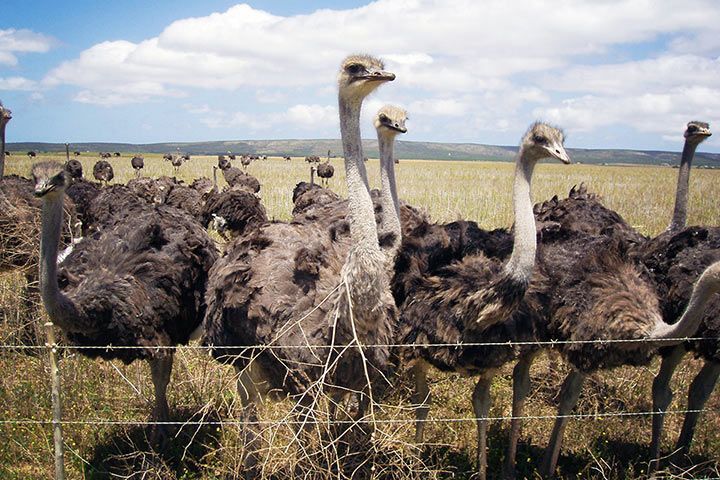
Ostriches are diurnal. They typically live in smaller groups, known as harems, which consist of one dominant male, a primary female, and several secondary females. This social structure allows them to have many eyes watching for danger while they feed.
Anatomy and Appearance
Size and Weight
The males reach a height of 6.8-9.1 feet (2.10-2.80 meters) - nearly as tall as a room ceiling! The females are slightly smaller, standing at 5.7-6.5 feet (1.75-2.00 meters). Males weigh between 220-300 pounds (100-135 kg), with particularly large individuals tipping the scales at 343-352 pounds (156-160 kg). The females weigh "only" 200-240 pounds (90-110 kg).
Long Neck
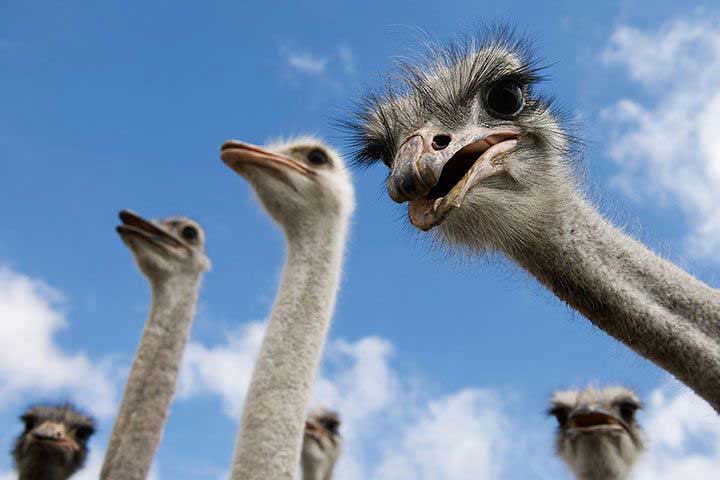
Ostriches have a long neck that constitutes almost half of their total height. It is slender yet very muscular and remarkably flexible.
Giant Eyes
With a diameter of about 5 cm, the ostrich's eye is the largest among all land vertebrates. It is even significantly heavier than its brain!
Tiny Brain
The enormous, beautiful eyes of an ostrich are larger than its brain, which weighs only 1.4 ounces (40 grams) – not even as much as two small chocolate bars.
Plumage
The rooster has a deep black plumage with bright white wing and tail feathers. The hen, on the other hand, is subtly colored in earthy brown to gray. This coloration provides perfect camouflage while nesting: the brown hen incubates during the day in the sand, while the black rooster remains invisible on the eggs at night in the dark.
Not one stomach, but three (!)
Unlike most birds, the ostrich has three stomachs. Each one serves a specific function – from salivating to grinding with swallowed stones, and finally to nutrient absorption. The digestion of food takes a remarkable 36 hours.
Only two toes on each foot
The ostrich is the only bird in the world with just two toes per foot (flying birds have four and other running birds have three). The larger toe is almost hoof-like and supports the entire weight, while the smaller toe helps maintain balance during fast running.
Ostrich Eggs
Ostriches Lay the Largest Eggs in the World
Ostrich eggs are the largest eggs available. A single person would find it quite a challenge to finish an entire ostrich egg omelette, as one egg is roughly equivalent to 20 chicken eggs.
However: Relatively the Smallest Eggs
The ostrich egg, weighing about 3.3 pounds (1.5 kg), is the largest egg in the animal kingdom. Yet, in relation to the size of the ostrich hen, it is the smallest bird egg on Earth. It constitutes only about 1 to 1.5% of her body weight. In contrast, for a small quail or a kiwi, the egg is proportionally gigantic.
Ostrich Eggs are Extremely Hard
An ostrich egg has such a thick shell that a person weighing 250 pounds (115 kg) can stand on it without breaking it. It’s also noteworthy that it is nearly impossible to open without a drill or other tools. Nevertheless, the tiny, adorable ostrich chicks manage to crack the egg by vigorously pushing their necks and feet against the inner walls.
Diet
Ostriches are omnivores. Their diet mainly consists of plants such as grasses, seeds, leaves, and roots. Occasionally, they also consume insects or lizards.
Behavior
Why Do Ostriches Swallow Stones?
Ostriches peck around 30,000 times a day, primarily to eat grains, leaves, and insects. Since they cannot chew, they ingest up to 3.3 pounds (1.5 kg) of small stones. They grind their food in their stomach.
Do Ostriches Bury Their Heads in the Sand?
The myth that ostriches bury their heads in the sand when threatened to become invisible is one of the most persistent misconceptions in the animal kingdom. No ostrich would willingly suffocate or blind itself to potential attacks. However, from a distance, it may appear that way—especially when they lie flat on the ground for camouflage, pecking for food close to the earth, or turning their eggs in the nest.
Why Do Ostriches Swallow Stones?
Ostriches peck up to 30,000 times a day to eat grains, leaves, and insects. Since they lack teeth, they need to break down their food in other ways: they consume up to 3.3 pounds (1.5 kg) of small stones (gastroliths). These stones act like grinding stones in a mill, crushing the food in their stomachs.
Do Ostriches Roar Like Lions?
Ostriches don’t sing, but they do hiss or clack their beaks. Male ostriches produce deep, booming sounds—this is known as "booming." The call of the males is so convincingly similar to a lion's roar that even experienced safari guides and predators can hardly tell the difference from afar. This roaring is used to establish territory.
Senses and Abilities
Ostriches Have Excellent Vision
Ostriches possess an exceptionally sharp sense of sight and often spot predators before other animals do. This is why hoofed animals like zebras and giraffes tend to stay close to them in the savannah. They know that if the ostrich looks confused, something is amiss!
The Fastest Bipedal Creatures
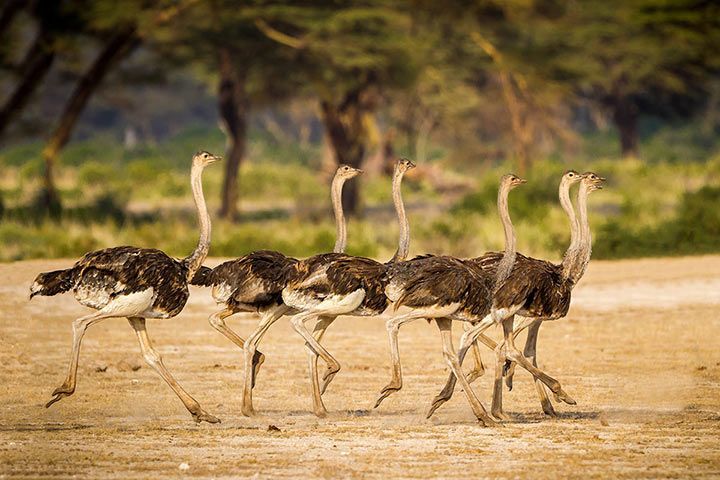
Ostriches can reach a top speed of 70 km/h. That’s more than enough for the highway! They are the fastest two-legged animals on the planet. However, despite their speed, they cannot fly because they are simply too heavy.
Long Strides When Running
When ostriches run, their powerful legs allow them to cover a distance of 11-16 feet (3.5-5 meters) in a single stride. How far can you go?
Are Ostriches Intelligent?
Standing up to 9.1 feet (2.8 meters) tall, ostriches can be quite intimidating. However, there’s a trick to make the ostrich think you’re the “stronger” one: hold a stick above your head. This makes you appear “taller” and automatically gives you the status of the “stronger” one. It turns out, ostriches can be easily fooled – despite their keen eyesight. 1.4 ounces (40 grams) of brain simply can’t process all information at lightning speed.
Weeks Without Water
Their scientific name Struthio camelus translates to “camel bird.” They earned this name due to their remarkable adaptation to desert life: ostriches can survive up to two weeks without drinking as they meet their hydration needs through the moisture in their food.
Life Expectancy
In the African savanna, healthy adult ostriches can live up to 30-40 years.
Enemies and Threats
Natural Enemies
Healthy adult ostriches have very few natural predators. They can even kill lions with a precise kick reminiscent of Jackie Chan. Their legs are incredibly strong, and each foot has a dagger-like claw that can grow up to 4 inches (10 cm long). Only sick ostriches or young chicks are at risk, as they are hunted by hyenas, leopards, or jackals.
Humans
According to the IUCN Red List, ostriches are generally considered "not endangered". However, in northern and eastern Africa, their habitat has shrunk significantly, putting them at risk, especially the Somali ostrich. This is primarily due to the conversion of savannas into grazing land for livestock. Additionally, ostriches are hunted for their meat, thick skin, and feathers. In Asia, they were completely wiped out for these reasons around the year 1966.
I saw ostriches in South Africa and fell in love instantly! Unfortunately, ostriches are almost exclusively kept to be exploited for their eggs, feathers, and meat - things no human needs to survive. Sometimes they are even forced to let people ride them, which puts them in absolute fear and panic. Just for our entertainment. I will never visit an ostrich farm again. I don't want to support this.
Silke from animalfunfacts.net
Reproduction
Male Make-Up
During the mating season, the bare skin on the legs and neck of the roosters turns a vibrant red. The more intense the color, the more attractive they appear to the hens.
Lion Roars as Love Songs
To capture the attention of the hens while keeping rivals at bay, the rooster emits a deep, resonant "Booming" sound. He inflates his neck like a balloon while doing so. This sound is so low that it can be heard for miles across the savannah.
The Courtship Dance
When a hen shows interest in a rooster, he begins to "dance":
- The rooster kneels in front of the hen (at the hock joints).
- He spreads his large black and white wings and rhythmically swings them from side to side.
- He swings his long neck from one side to the other and gently taps the back of his head against his own back.
- As he flaps his wings, the feathers shimmer in the sunlight, creating a hypnotic effect on the hens.
The Communal Nest
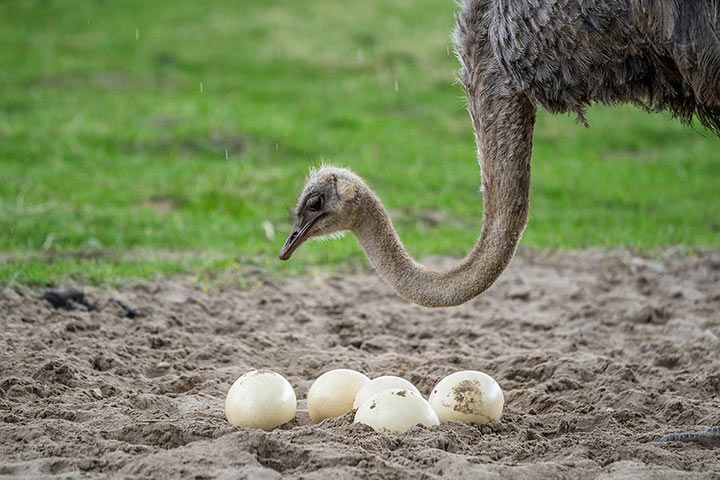
Once the hen has agreed and they have mated, the male scratches out a shallow depression in the ground – the communal nest. Here, all the hens in the group lay their eggs, often resulting in 20 to 60 eggs in one nest.
Teamwork in Incubation
The lead hen incubates during the day, as her inconspicuous plumage blends perfectly with the sandy ground. The rooster takes over the night shift, as his black feathers make him nearly invisible in the dark. After about 42 days, the chicks hatch. However, reproduction in the wild is tough: only about 15% of the chicks survive their first year, as they are easy prey for predators.
The Chief Hen Recognizes Her Own Eggs
The main hen possesses a remarkable ability: even with up to 60 eggs in the communal nest, she can accurately distinguish her own eggs from those of the other hens. Before she starts incubating, she carefully rolls her eggs into the safest position – precisely in the center of the nest, where they are best protected.
Chick Power from the First Month
Newly hatched ostrich chicks are already the size of a small chicken. They grow rapidly: in the first 6 months, they can gain about 10 inches (25 cm) per month. By just one month old, they can run at speeds of up to 35 mph (56 km/h) to keep up with the fleeing herd.
Fun Facts
Ostrich Feathers are Antistatic
Antistatic dust cloths are quite popular because they magically attract every speck of dust. Ostriches could do their own house cleaning with their feathers, as they have the only antistatic feathers in the entire animal kingdom.
The Ostrich Is Related to:
- Cassowary
- Elephant Bird
- Emu
- Kiwi
- Moa
- Rhea
Animals in the Same Biome:
- Antelope
- Elephant
- Meerkat
- Vulture
- Cheetah
- Giraffe
- Wildebeest
- Hyena
- Leopard
- Lion
- Rhinoceros
- Jackal
- Zebra
Sources:
- Phylogeographic Patterns in Mitochondrial-DNA of the Ostrich (Struthio-Camelus) (https://academic.oup.com)
- Breeding biology of ostriches (Struthio camelus) in the Serengeti ecosystem, Tanzania (https://onlinelibrary.wiley.com)
Recommended Articles:
Recommended Videos:


All About Birds