Sperm Whale
Sperm Whale Facts
| Size | 32-66 feet (10-20 meters) |
| Speed | Up to 23 mph (37 km/h) |
| Weight | 15-55 tons |
| Lifespan | 50-70 years |
| Food | Squids, octopuses, sharks |
| Predators | Sharks, orcas (young, old or inujured sperm whales) |
| Distribution | All oceans |
| Habitat | Open sea, deep sea, coast |
| Order | Whales |
| Suborder | Toothed whales |
| Family | Physeteroidea |
| Scientific name | Physeter macrocephalus |
| Characteristics | Large whale with a huge, rectangular head |
Main Characteristics
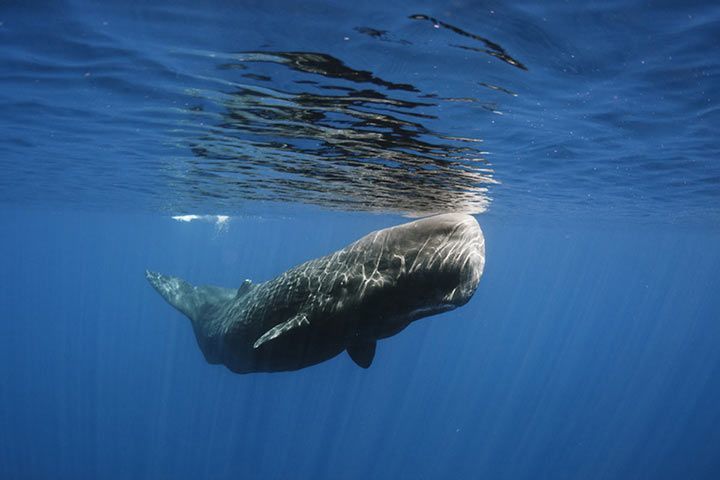
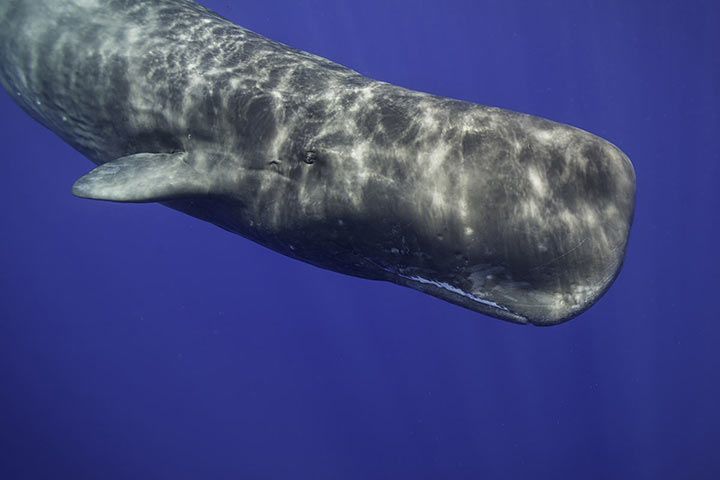
The sperm whale is a large marine mammal. Its most distinctive feature is its large, rectangular head, making it easily recognizable! Among all living beings on Earth, it possesses the heaviest brain, weighing up to 19.8 pounds (9 kg). Given the size of its skull, this is no surprise! Additionally, it is the largest toothed whale and the biggest predator that inhabits the ocean.
Species
There are three species of sperm whales: the large sperm whale and two species of pygmy sperm whales. The pygmy sperm whales are particularly fascinating as they can expel a dark, ink-like liquid to escape from predators, much like an octopus! Pygmy sperm whales are significantly smaller and lack the rectangular head, which is why they are classified in their own scientific category.
Name
The sperm whale got its name from the spermaceti found in its head. In the past, people thought that this waxy substance was actually the whale's semen.
Distribution and Habitat
Sperm whales are found in nearly all oceans. They are among the most widely distributed whales. However, they are most commonly found in tropical and subtropical waters. Only the males undertake long migrations to the polar seas and back.
Way of Life
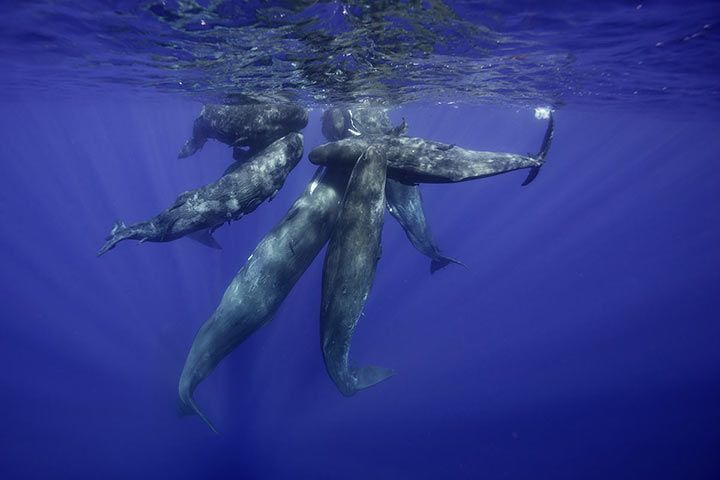
Sperm whales form groups of 15-20 individuals. The females, calves, and young males remain in warmer waters year-round. The adult males migrate alone between warm and cold seas, covering distances of 2,500-5,000 miles (4,000-8,000 km).
Anatomy and Appearance
Size and Weight
Sperm whales can reach lengths of 32-66 feet (10-20 meters) and weigh between 15-55 tons. There is a significant size difference between males and females, with males being up to three times larger and heavier than females.
Large, Rectangular Head
The enormous, rectangular head constitutes about one-third of its total length.
Spermaceti
In addition to the brain, there is a unique organ within the head: the so-called spermaceti organ. It is filled with 'spermaceti', a light, waxy oil. The colder the water, the thicker it becomes. The whale needs this to dive particularly deep. In the past, sperm whales were hunted for their spermaceti.
Largest Brain
Among all the animals on Earth, the sperm whale has the largest and heaviest brain. It can weigh up to 19.8 pounds (9 kg), which is about six times heavier than a human brain. Interestingly, in relation to its size, it is quite light, making up only 0.02% of its total body weight.
Largest Jaw
The sperm whale possesses the largest jaw of all whales. Theoretically, it could even swallow a whole human! However, we are not on its menu.
Cone-Shaped Teeth
The sperm whale is the largest toothed whale, even though it has only 40-52 teeth in total. All of these cone-shaped teeth are located in the lower jaw and fit into the "empty tooth sockets" in the upper jaw. The upper jaw looks toothless because the teeth are often covered by the gums. By the way, a "normal" dolphin can have up to 200 teeth.
Unique Blowhole
The sperm whale is unique among whales for having just one blowhole. It is not located exactly in the center but slightly to the left. When it exhales, it creates an impressive fountain.
Short Fins
Sperm whales have the shortest pectoral fins of any whale, measuring only 1.5 m in length. Given their body length of up to 66 feet (20 meters), this accounts for less than 10% of their size. Like most whales, instead of a dorsal fin, they have a sort of hump. Their tail fins are small and triangular.
Sperm Whale vs. Blue Whale – What’s the Difference?
The blue whale is the largest baleen whale, while the sperm whale is the largest toothed whale. However, they couldn't be more different! The blue whale weighs four times as much and is 1.5 times as long, has baleen instead of teeth, a flat head with a narrow ridge, and primarily feeds on krill.
Diet
Sperm whales are carnivorous. They require about 3% of their body weight in food each day. For a weight of 55 tons, that amounts to over 3,300 pounds (1,500 kg) daily. Their favorite prey includes squids like the giant squid, which they hunt at great depths. They also catch small sharks and large fish such as tuna, cod, and monkfish.
Behavior
Blow
Among all whales, the sperm whale produces one of the most impressive spouts, as its blowhole is not perfectly centered, causing the spout to angle forward and upward. The fountain reaches heights of 16-22 feet (5-7 meters).
Hunting
Sperm whales use echolocation to locate their prey. They emit clicking sounds, and when they encounter a target, the sound bounces back to them, allowing the sperm whale to determine the direction in which to swim. Additionally, the quicker the sound returns, the more they can gauge the distance to the prey. When they are close enough, they catch their meal with their teeth.
Sleeping
It looks quite funny: In the wild, sperm whales sleep about 7% of the time vertically with their heads pointing upwards in the water. Scientists have not yet fully solved this mystery. They suspect that the whales can sleep in this position using both hemispheres of their brains. Typically, they only sleep with one hemisphere, allowing them to continue swimming and breathing.
Are Sperm Whales Dangerous?
Sperm whales have impressively large teeth and are the largest predators in the ocean. However, they are not aggressive towards humans, but rather, they are peaceful and calm. There is not a single report of a sperm whale having eaten a human—intentionally or otherwise. Nonetheless, there are divers who pursue sperm whales to touch them or capture a great selfie or photo with them. It’s no wonder they seek to escape, sometimes accidentally hitting a diver with their tail.
Senses and Abilities
Diving
• Depth
Alongside the Cuvier's beaked whale and the Southern elephant seal, the sperm whale is one of the mammals capable of diving to great depths. In 1969, whalers killed a specimen 100 miles (160 km) south of Durban (South Africa) that had sharks in its stomach. Specifically, a type of shark that lives exclusively near the ocean floor – at depths exceeding 10.475 feet (3,193 meters). Therefore, it is believed that the sperm whale can dive deeper than 9,800 feet (3,000 meters).
• Duration
The sperm whale is a master at holding its breath. It can dive continuously for up to 1 hour and 52 minutes without taking a breath! Among marine mammals, it can stay underwater the second longest, with only the Cuvier's beaked whale diving longer.
Sounds
• Click Sounds
Sperm whales produce clicking noises to navigate through the ocean and locate prey. Their echolocation works similarly to that of bats, but underwater. However, clicks are not the only sounds they make. They also grunt, whistle, chirp, ring, squeak, bark, and wheeze. These sounds can be heard underwater for kilometers.
• Volume
Sperm whales are considered the loudest animals on Earth: their sounds can reach 230 dB. A jet engine is only 120-140 dB loud when you are in close proximity. This raises the question: What happens if a diver swims next to a sperm whale? Does their eardrum burst? Sounds are measured differently underwater than above. 230 dB underwater is only about 170 dB. That is still very loud and could indeed damage a human's eardrum.
Speed
Typically, sperm whales swim at a speed of about 3-9 mph (5-15 km/h). However, they can also 'sprint' and reach speeds of up to 23 mph (37 km/h).
Intelligence
Sperm whales possess the largest and heaviest brain, but how intelligent are they? The size and weight of a brain don't always indicate an animal's cleverness. Sperm whales exhibit strong social behaviors, adapt their actions to new situations, share knowledge with their peers, and experience emotions such as grief. So, yes, sperm whales are indeed intelligent!
Life Expectancy
Sperm whales can live up to 60 years, although they usually do not reach this age due to human activities.
Enemies and Threats
Natural Enemies
Adult sperm whales have no natural predators. Only young, old, or injured whales may fall prey to orcas.
Humans
Ships, Fishing, Pollution, and Noise
The greatest threat to sperm whales comes from humans. These animals can suffer fatal injuries from collisions with ships. They can become entangled in fishing nets and drown. The noise from ships creates so much stress that they mate less frequently. Pollution from mercury, plastic, and other toxins severely affects their organs, leading to miscarriages or even death. These issues are not only faced by sperm whales but by nearly all marine animals.
Sought-After Spermaceti
In the past, hunting sperm whales was a major issue. Not only was their meat sought after, but the spermaceti found in their heads was also highly valued for making candles, oil lamps, and lubricants.
Precious "Whale Vomit"
Yes, you read that correctly. Inside the stomachs of sperm whales, a substance can form that is referred to as whale vomit. It may sound disgusting, but it is considered "floating gold" because it is extremely valuable for perfume production. It helps scents last longer. Officially, it is known as "ambergris". This whale vomit consists of indigestible parts of their prey that, through digestive juices, turn into a waxy substance. It is either vomited or excreted, floats in the ocean, and sometimes washes ashore. One kilogram can be worth tens of thousands of euros.
Conservation Status
The sperm whale is classified as an endangered species. There used to be about 1.1 million individuals before they were heavily hunted. Fortunately, since 1986, hunting sperm whales has been prohibited. By 1990, the population was around 360,000. Today, it is estimated to be about 300,000 due to many whales dying from fishing nets, noise, pollution, and collisions with ships.
Helping Sperm Whales
You can easily and affordably help sperm whales from the comfort of your home! Opt for local products that do not require shipping. This results in fewer ships, reducing collisions and underwater noise. By eating less fish, there will also be fewer fishing boats, which means fewer sperm whales getting caught in nets and drowning.
Importance for the Ecosystem
Sperm whales play a crucial role in the ecosystem. They help to bind CO2, reducing its presence in the atmosphere. This occurs as follows: they bring food from the deep sea to the surface, where they digest and excrete it. Their waste promotes the growth of small algae, known as phytoplankton, which "swallow" CO2 from the air.
Reproduction
Typically, adult male and female sperm whales live in separate groups. However, during mating season, they come together again. Females give birth to a calf every 5-7 years. The gestation period lasts 14-16 months. At birth, a calf measures about 13-16 feet (4-5 meters) in length and weighs around 2,200 pounds (1,000 kg). It is nursed for one to two years and protected by older whales. Since
Animals in the Same Biome:
- Atlantic Puffin
- Elephant Seal
- King Penguin
- Octopus
- Orca
- Polar Bear
Sources:
- „Stereotypical resting behavior of the sperm whale“ (https://www.frontiersin.org)
- „Sperm whale predator-prey interactions involve chasing and buzzing, but no acoustic stunning“ (https://www.nature.com)
- „Heaviest brain“ (https://www.guinnessworldrecords.com)
- „Largest jaw – mammal“ (https://www.guinnessworldrecords.com)
- „Largest toothed mammal“ (https://www.guinnessworldrecords.com/world-records/449716-largest-toothed-mammal)
- „Loudest animal sound“ (https://www.guinnessworldrecords.com)
Related Articles: