Fin Whale
Fin Whale Facts
| Size | 69-89 feet (21-27 m) |
| Speed | Up to 28 mph (46 km/h) |
| Weight | 40-80 tons |
| Lifespan | 80-90 years |
| Food | Krill, little schooling fish, crustaceans |
| Predators | Big sharks |
| Habitat | All oceans of the world |
| Order | Whales |
| Suborder | Baleen whales |
| Family | Rorqual |
| Scientific name | Balaenoptera physalus |
| Characteristics | The second largest whale; it has differently colored lower jaws |
Main Characteristics
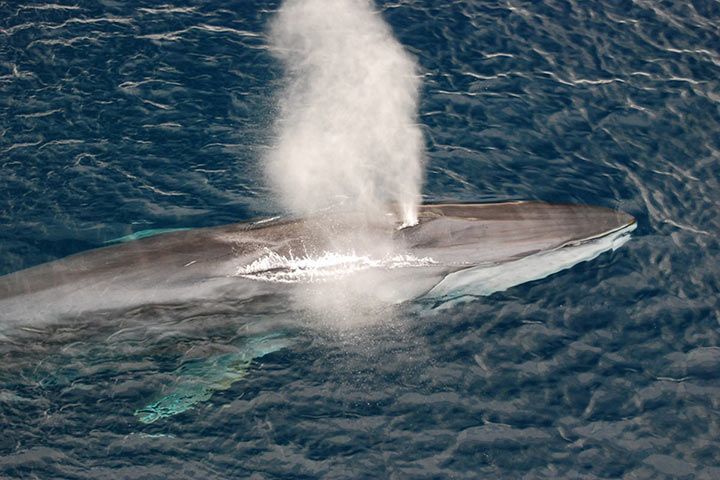
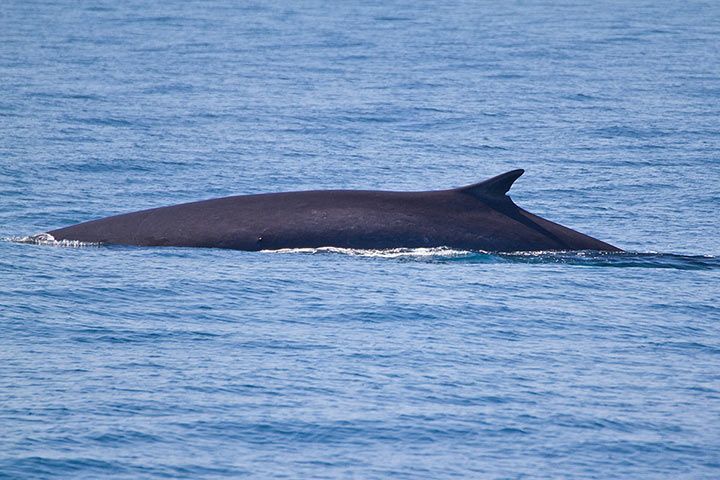
Fin whales are marine mammals and the second largest animals on the planet. They can grow up to 88 feet (27 meters) in length, making them nearly as long as blue whales. However, they are significantly slimmer and lighter, weighing less than half as much. Fin whales are the second fastest whales, which is why they are often referred to as the "greyhounds of the sea". Their most distinctive feature is their differently colored lower jaw. The left side is dark while the right side is light. Additionally, the baleen plates are also differently colored on each side. Their dorsal fin is hook-shaped, and there is a ridge that runs along their back.
Animal Family
The fin whale belongs to the rorqual family and is characterized by the presence of throat grooves. These are longitudinal folds that extend from the throat to the middle of the body. They can stretch to take in as much food as possible, much like an accordion.
Distribution and Habitat
Fin whales inhabit all oceans. Most of the time, they are found in open waters or along coastlines where the water quickly becomes very deep. They spend the summer in warmer seas and migrate to the fish-rich waters of the Arctic and Antarctic during the winter.
USA
In the United States, the majority of fin whales inhabit the waters off California, Hawaii, and Alaska.
Mediterranean Sea
Fin whales can also be found in the Mediterranean. Some even reside there year-round. During the summer, a particularly large number of fin whales gather in the Pelagos Sanctuary, located between Italy, France, and Monaco. They are also frequently spotted in the Strait of Gibraltar, which lies between Spain and Morocco. Very rarely, they are observed in the Adriatic Sea off the coasts of Croatia and Slovenia.
North and Baltic Seas
Young fin whales sometimes stray into the North Sea and the Baltic Sea, often following a school of fish.
Way of Life
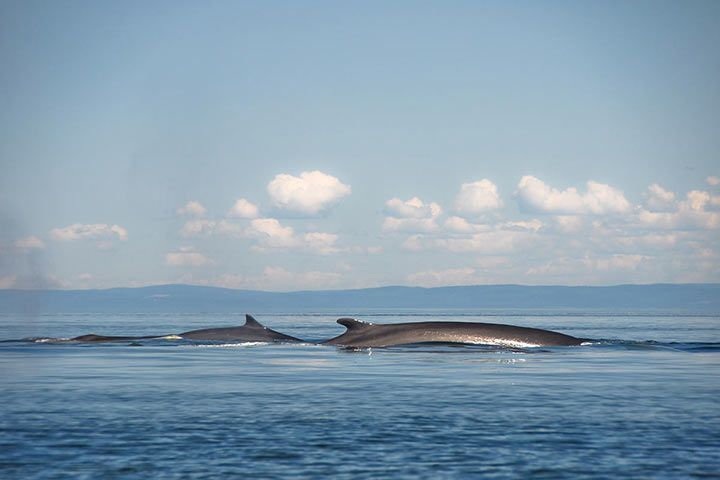
Fin whales are generally solitary creatures, but they occasionally form small groups of 4-6 individuals.
Anatomy and Appearance
Size and Weight
Typically, fin whales reach lengths of 68-72 feet (21-22 meters) and weigh between 40-50 tons. Some particularly large individuals can grow to 85-89 feet (26-27 meters) long and weigh as much as 70-80 tons.
Color
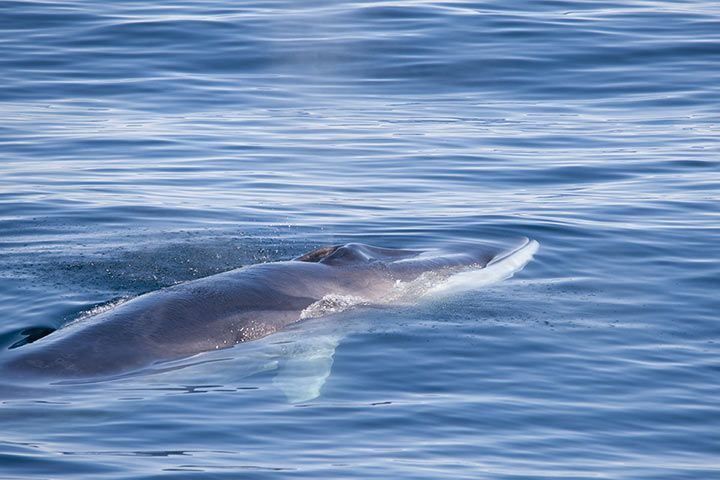
What sets fin whales apart from other whales is their unique coloration: the lower lip, mouth cavity, and baleen on the right side are light, while the left side is gray. Researchers believe this may assist in hunting for schooling fish and crustaceans. The rest of the body is uniformly colored, with the fin whale being dark gray to brownish-black. The sides, belly, and undersides of the fins are lighter.
Baleen Plates
Like all baleen whales, fin whales have numerous elongated horn plates in their mouths to filter food from the water. These are known as baleen. A fin whale has between 350-400 of these plates.
Throat Grooves
The fin whale is part of the family of rorquals, which is a suborder of baleen whales. It has clearly visible grooves that start at the lower jaw and extend to the middle of its body. These grooves resemble large folds and are about 2 inches (5 cm) deep. When fin whales "gulp" water to filter out fish and krill, the folds stretch and the mouth expands. This allows them to take in more water – and consequently more food.
Diet
Fin whales are carnivorous. They consume up to two tons of krill, small schooling fish, and crustaceans daily.
Behavior
Hunting Strategy
When fin whales hunt, they swim through the ocean with their mouths open, "gulping" between 60 and 80 tons of seawater (which is about their own weight!). Just like a pasta strainer, the water flows out through the baleen, but the food remains in their mouths.
Sounds
Fin whales produce sounds that are very low in frequency. They have the second lowest frequency in the animal kingdom, ranging from 16 to 40 Hertz. Only the song of the blue whale is deeper. Hertz is the unit used to measure "pitch". The range of 16 to 40 Hertz is just within the limits of human hearing, as we can perceive frequencies between 20 Hertz and 20 kilohertz.
Abilities and Senses
Speed
Fin whales are quite fast. With their sleek, torpedo-shaped bodies, they can reach speeds of up to 28 mph (46 km/h). This is why they are often referred to as the 'greyhounds of the sea'. Only the sei whale is faster.
Diving
When fin whales dive, they typically do not go deeper than 650 feet (200 meters). Usually, they stay underwater for about 6 minutes, but they can hold their breath for up to 17 minutes.
Life Expectancy
Fin whales can live for over 100 years. In 2010, a dead whale was recovered off the coast of Denmark that was 140 years old. Unfortunately, these animals rarely reach such ages due to human activities. Typically, they live around 80 to 90 years.
Enemies and Threats
Natural Enemies
Adult fin whales have no natural predators. However, young, old, or sick individuals are sometimes preyed upon by orcas.
Human Impact
Hunting fin whales has been prohibited since 1986. Nevertheless, these animals face a range of human-made dangers:
Vessel Strikes
Fin whales are often injured by ship propellers, resulting in fatal injuries.
Fishing
There is no escape from the large nets of deep-sea trawlers. Fin whales can become entangled and drown tragically. Additionally, they are finding less and less food. The oceans are heavily overfished due to our high fish consumption. A simple and effective way to help them is to eat less fish. Fin whales cannot survive without fish, but we humans can.
Noise
The noise from ships has led to a decrease in fin whale mating. Typically, they find partners through their songs, but the noise prevents them from hearing each other and leads to increased stress levels.
Climate Change
Fin whales are known for their migratory habits. They constantly "commute" between warm waters (for mating) and cold waters (for feeding). However, climate change has led to rising sea temperatures, which negatively impacts the whales. They are struggling to find enough food.
Pollution
Every day, the pollution of the oceans with mercury and other toxins increases. As a result, marine animals suffer from organ diseases and face challenges with infertility.
Conservation Status
Just a few decades ago, there were nearly 500,000 fin whales in the world. Current estimates from the IUCN paint a less optimistic picture. There are about 70,000 whales in the North Atlantic, 50,000 in the North Pacific, and 25,000 in the Southern Hemisphere left. Consequently, the IUCN classifies the fin whale as an endangered species.
Importance for the Ecosystem
Fin whales are considered a keystone species. This term refers to species that are not very numerous but have a significant impact on their ecosystem. Their absence can adversely affect many other animal species. Fin whales help maintain the balance of krill populations and transport nutrients to various plant and animal species while diving. Their feces promote the growth of phytoplankton, which in turn produces a substantial amount of oxygen that we need to breathe.
Reproduction
The reproduction of fin whales is not well understood. The gestation period is about one year. At birth, a calf is approximately 20 feet (6 meters) long, and within 6 months, it can grow to be twice that size.
Animals in the Same Biome:
- Albatross
- Atlantic Puffin
- Blue Whale
- Sharks
- Loggerhead Sea Turtle