Sloth
Sloth Facts
| Size | 16-31 inches (42-80 cm) |
| Speed | 6-8 feet (1,8-2,4 m) per minute |
| Weight | 4.4-24 pounds (2-11 kg) |
| Lifespan | 25-40 years |
| Food | Leaves, fruits |
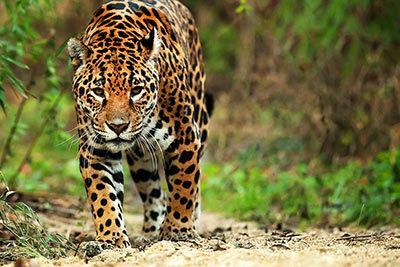
| Predators | Eagles, snakes, jaguars |
| Habitat | Central and South America |
| Order | Pilosa |
| Family | Sloths |
| Scientific name | Folivora |
| Characteristics | Mammal that moves very slowly; hangs upside down in the tree |
Main Characteristics
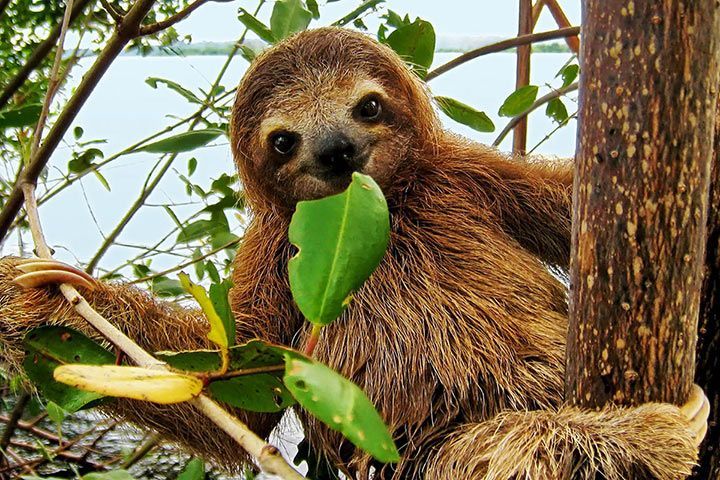
Sloths are mammals that inhabit tropical rainforests and spend most of their time hanging upside down from branches. Their most distinctive features include long claws and thick fur, which often hosts algae. They move at a very slow pace and are even considered the slowest mammals on the planet. Despite having some similarities to primates and bears, they are not related to them; instead, they belong to the family of sloths.
Species
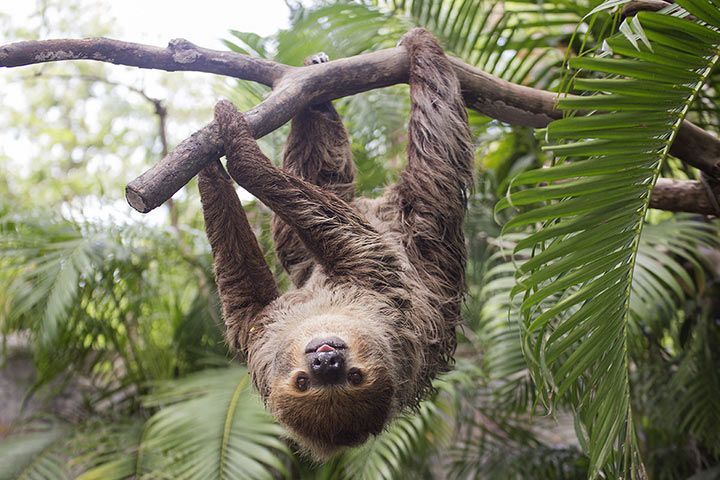
There are two species: the two-toed sloths and the three-toed sloths. A more suitable name would be two-fingered and three-fingered sloths, as they differ in the number of their fingers, not in the number of their toes. They also differ in size, as two-toed sloths are significantly larger than three-toed sloths.
Distribution and Habitat
Sloths are found in Central and South America. They primarily inhabit Brazil, Venezuela, Colombia, Panama, Costa Rica, Ecuador, and Bolivia. Their habitat consists of warm, humid tropical rainforests.
Way of Life
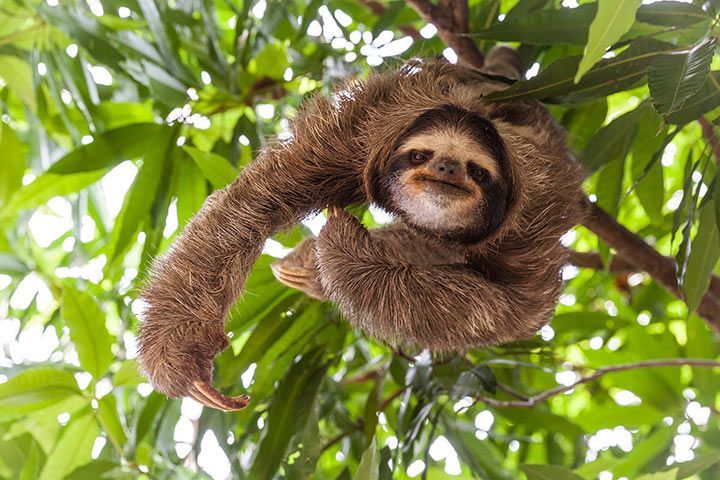
Sloths are solitary creatures. They spend nearly their entire lives in trees. Their long claws assist them in hanging upside down from branches. In this position, they do almost everything. They sleep, eat, mate, and give birth to their young. They only climb down for bathroom breaks or to find a new tree. Even in death, they remain hanging on the branch due to their strong grip. Sloths are neither diurnal nor nocturnal. When they feel tired, they take a nap.
Anatomy and Appearance
Size and Weight
Sloths can grow to be 16-31 inches (42-80 cm) in length and weigh 4.4-24 pounds (2-11 kg).
Claws
Sloths have claws that can grow up to 4 inches (10 cm) long. They are curved to help them grip branches more effectively.
Neck Vertebrae
Sloths have extra neck vertebrae. This allows them to rotate their heads up to 270 degrees, enabling them to reach more leaves without needing to move.
Fur
Undercoat and Outer Layer
A healthy, thick coat is crucial for the sloth, as it helps maintain its body temperature effectively. The coat is made up of a soft, dense undercoat and a coarser outer layer.
Parting
Almost all mammals have their parting on their head or back, with their hair growing towards the arms and legs. However, for the sloth, the parting is located on its belly. And that's a good thing. Since it hangs upside down in the tree, rainwater flows off its fur more effectively.
Insect "Roommates"
Sloths have a "living fur"! Within it, moths and other insects reside. Some species of moths are found exclusively in sloth fur. They exist nowhere else in the world.
Alge and Fungi
Even algae and fungi thrive in the sloth's fur. The fungi even possess antibacterial properties, helping to protect it from inflammation.
Symbiosis
When two living beings benefit from cohabitation, it is referred to as symbiosis. This is the case with the sloth and the algae. The algae enjoy an ideal habitat, and in return, they provide the sloth with excellent camouflage. But what about the moths? Biologists suspect that they feed on the algae and lay their eggs in the sloth's droppings. Whether and what advantage the sloth gains from this is still uncertain.
Diet
Sloths are herbivores. They primarily feed on young leaves. Typically, they have 7-12 favorite trees, such as the cacao tree, the ant tree, and the kapok tree. It can take them anywhere from 7 to 28 days to digest a leaf (!).
Behavior
Are Sloths Lazy?
That depends on your perspective. We often equate slowness with laziness. When the first naturalists discovered a sloth, they observed that it hardly ever moved. From their viewpoint, it was a "lazy" animal. This is the reason why it's called „Faultier“ (= „lazy animal“) in German.
Sleeping
Until now, it was believed that sloths sleep for 15-20 hours a day. This would mean that a 40-year-old sloth would spend nearly 34 years of its life sleeping. However, a few years ago, biologists observed wild sloths and discovered that this is not the case. They actually sleep only 8-10 hours a day. Previously, only captive animals were studied. In captivity, they behave differently because they don't have to fear predators and are fed regularly. As a result, they tend to sleep more there.
Hanging Out
When we humans cling to a branch, it can be quite exhausting. However, sloths require almost no strength to "hang out" because they have curved claws along with unique muscles and tendons. Some even remain hanging in the tree after they have passed away.
Moving on the Ground
The legs and arms of a sloth are not designed for walking on the ground. To move on the ground, it digs its front claws into the earth and pulls itself forward on its belly. It may look quite clumsy, but it works!
Camouflage
The green algae in their fur make sloths appear almost plant-like. Additionally, the algae give them a "plant-like scent". This makes them "invisible" to predators with a keen sense of smell - or more accurately, "odorless." Their extremely slow movement also serves as a form of camouflage, as predators primarily notice quick movements. When they spot a predator, they usually remain completely still.
Defense
When a sloth is threatened and has no other escape, it defends itself using its sharp claws and teeth.
Are Sloths Dangerous to Humans?
Sloths are not aggressive and they are not poisonous. However, if they feel threatened, they can inflict serious injuries on us with their teeth and claws. Since their fur harbors a variety of bacteria and fungi, a bite could potentially transmit these, leading to rapid infection of the wounds.
Why Do Sloths Climb Down From Trees?
„Bathroom Visit“
Sloths climb down their trees every five days to relieve themselves. During this "session," they can lose up to a third of their body weight! Why don't they just let their droppings fall to the ground? After all, they are safe from most predators while in the trees. Additionally, climbing takes a lot of energy. Biologists have two theories:
1. Symbiosis Between Sloths, Moths, and Algae
It was previously thought that a cycle was responsible for sloths climbing down for their "business":
Sloth poop for the moth larvae -> Moth nutrients for the algae -> Algae snack for the sloth
The moths that live in sloths' fur lay their eggs in their droppings, and their larvae feed on it. In return, the moths provide nutrients to the algae. The sloth benefits too: it can snack on algae whenever it wants. So, the sloth has a reason to ensure that the moths find a big, intact pile of droppings instead of poop scattered all over the ground. However, no algae have ever been found in sloth droppings. Therefore, this assumption might be incorrect.
2. Behavior of the Ancestors
Currently, the biologists believe that the behavior may originate from the ancient sloths that lived on the ground rather than in trees 10,000 years ago.
Senses and Abilities
Senses
Sloths have poor eyesight and hearing. They rely on their excellent sense of smell and touch.
Body Temperature
Healthy individuals typically have a body temperature of 97.7 degrees Fahrenheit (36.5 degrees Celsius). However, for sloths, it is only about 91.4 degrees Fahrenheit (33 degrees Celsius). They need to bask in the sun when they feel cold and seek shade when they start to sweat – quite similar to reptiles. During sleep, their temperature can even drop to 73.4 degrees Fahrenheit (23 degrees Celsius).
Digestion
Sloths can only survive in warm, tropical regions. If it gets too cold, the bacteria in their digestive system die, leading to starvation – even if their stomachs are full! Therefore, they prefer to eat on particularly hot days.
Intelligence
The sloth presents many puzzles to biologists: Why does it climb down to the ground? What role do the moths play? Why do they have such a low body temperature? How long can they live? Here's another question: Are sloths intelligent? Unfortunately, there are very few significant studies on this topic as well. Researchers currently only know that they have an excellent spatial memory.
Speed
The sloth is officially recognized as the slowest mammal in the world. Even when it feels threatened, it can only reach a speed of 6-8 feet (1,8-2,4 m) per minute. Therefore, to cover a distance of 100 meters, it would take about 42-55 minutes. In contrast, the fastest human can do it in just 9.58 seconds.
Swimming
Surprisingly, sloths are excellent swimmers. The numerous leaves that slowly ferment in their digestive system provide buoyancy - much like a flotation device. They propel themselves forward using their front limbs in a crawling motion.
Jumping
Sloths move at a very slow and leisurely pace. They cannot jump from branch to branch like primates do. Their bodies are not built for that.
Life Expectancy
In the wild, sloths can live for 20 to 30 years. At least, that's what is believed. The oldest sloth on record lived to be 54 years old, but it was in captivity.
Ememies and Threats
Natural Enemies
Their natural enemies include jaguars, ocelots, harpy eagles, and snakes.
Human Impact
The biggest threat to sloths comes from humans. They suffer from habitat loss due to deforestation and road construction. Many are involved in traffic accidents and are affected by power lines. Additionally, they are captured and sold as pets.
Conservation Status
Are sloths endangered? Fortunately, sloths are (currently) not considered an endangered species. Only two subspecies are at risk: the collar sloth and the pygmy sloth.
Importance for the Ecosystem
The sloth plays a crucial role in its ecosystem. In fact, it has its own mobile mini-ecosystem, as its fur provides a habitat for mosquitoes, sand flies, lice, mites, ticks, beetles, and moths.
Can Sloths Be Pets?
Sloths are wild animals and thus not suitable as pets. They have very specific habitat requirements that are difficult to meet. As a result, most of them do not survive for long. Additionally, they possess long, sharp teeth and claws that can seriously injure a person.
Reproduction
Mating
Three-toed sloths try to attract a mate through sounds and calls, while two-toed sloths mark their territory with scents. The males fiercely compete for the females by biting and using their claws. Occasionally, they even fall from the tree during these confrontations. The mating process is quite rapid – which is unusual for sloths. It lasts less than a minute.
Gestation Period and Birth
Three-toed sloths have a gestation period of 6 months. In contrast, two-toed sloths have a gestation period of 12 months. Just before giving birth, the mother climbs onto a low branch, so if the baby falls, it won't fall far. The baby weighs between 10-18 ounces (300-500 grams), is born with its eyes open, and already has claws. It is nursed with milk and starts nibbling on leaves just a few days after birth. For the first few weeks, it clings to its mother's belly.
Reproduction Cycle and Raising the Young
Sloths give birth to a baby only once every two years. Three-toed sloths raise their young for six months, while two-toed sloths only let their babies go after 12 months.
Evolution and History
10,000 years ago, giant sloths roamed the earth, weighing as much as elephants. Unlike their modern relatives, they didn't dwell in trees but rather on the ground. Remarkably, they could even stand on their hind legs like bears.
Fun Facts
Zootopia
In the animated movie Zootopia, there are sloths named Flash and Priscilla. They work at the DMV and process all applications... very slowly!
Ice Age
In Ice Age, there is a giant sloth named Sid. He is quite clumsy and often finds himself in trouble.
In German
In German, the word for sloth is "Faultier," which literally translates to "lazy animal".
The Sloth Is Related To:
Animals in the Same Biome:
Sources:
- „Oldest sloth in captivity ever“ (https://www.guinnessworldrecords.com)
- „Why Do Sloths Really Poop on the Ground?“ (https://slothconservation.com)
- „Why sloths defecate on the ground: rejection of the mutualistic model“ (https://www.researchgate.net)
- „Anthropogenic modification of a giant ground sloth tooth from Brazil supported by a multi-disciplinary approach“ (https://www.researchgate.net)
- „The behaviour and activity budgets of two sympatric sloths; Bradypus variegatus and Choloepus hoffmanni“ (https://peerj.com)
- „Grip it good: in vivo grip force across substrate diameters in the brown-throated three-toed sloth (Bradypus variegatus)“ (https://zslpublications.onlinelibrary.wiley.com)
Video: 15 Facts About Sloths
(Video opens on YouTube)
Related Articles:
Recommended Videos:


All About Mammals