All About Cephalopods
Eight to ten arms, dark ink, and a clever mind – the superpowers of cephalopods!
What Are Cephalopods?
Cephalopods are mollusks. They exclusively inhabit the sea. They come in a wide range of appearances and sizes, from small species found along the coast to gigantic ones living in the deep sea. The most well-known include octopuses, squids, and cuttlefish.
Main Characteristics of Cephalopods
1. Eight to Ten Arms
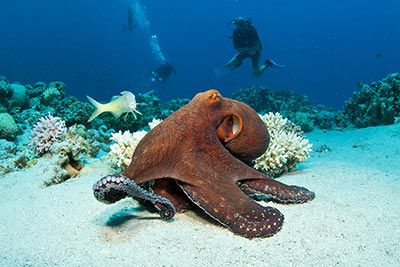
Cephalopods have arms that are directly attached to their heads, which they use for hunting and movement. They are categorized into eight-armed and ten-armed cephalopods. The eight-armed ones include octopuses, while the ten-armed ones consist of cuttlefish and squids. If an cephalopod loses an arm, it can regrow it within a few months. Among all animals in the world, octopuses have the most flexible arms. They can twist them in any direction and even change their length. They also have a favorite arm: it is always the second arm from the center.
2. Ink for Defense
Cephalopods are named for their ability to confuse attackers by releasing a dark liquid when threatened. This liquid resembles ink. They store this dark fluid in their ink sac.
3. High Intelligence
Cephalopods are among the most intelligent and sensitive invertebrates. Their memory surpasses ours. They even dream.
Cephalopod Family Tree
Amazing Facts About Cephalopods
- There are approximately 800 species of cephalopods.
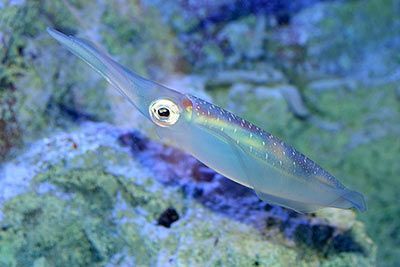
- Octopuses, cuttlefish, and squids are all part of the cephalopod family.
- Cephalopods have three hearts. Two of the hearts supply their arms, while the third one pumps blood to their body.
- Cephalopods have blue blood – because it contains a lot of copper.
- Cephalopods are carnivores. They mainly eat crabs, shrimp, and small fish.
- They catch their prey with their tentacles and bring it to their mouth. The mouth is located in the middle of their underside. It is quite hard and looks like a parrot's beak.
- Cephalopods can change their color in just seconds. They use this skill to blend in - for defense or hunting.
- When they feel threatened, they confuse their attackers by spraying a dark liquid that resembles ink.
- If a cephalopod loses an arm, it can grow it back in just a few months.
- Cephalopods are really smart and sensitive animals. Their memory is even better than ours. They can even dream.
- Among all animals, octopuses have the most flexible arms. They can twist them in any direction and even change their length. They also have a favorite arm: it's always the second arm from the center.
- The firefly squid has special color cells that can produce light. This ability is called bioluminescence. It uses the light for communication, camouflage, and to attract prey.
- Cephalopods usually live at depths of up to 650 feet (200 meters).
- However, there are also species that inhabit much deeper areas. The bigfin squid can survive at a depth of 20,381 feet (6,200 meters), and the Dumbo octopus can live at 22,825 feet (6,597 meters).
- The largest octopus is the Pacific giant octopus. It can have a wingspan of up to 32 feet (9.75 meters) and weigh as much as 600 pounds (272 kg).
- The largest squid is the colossal squid. It can have a wingspan of 32-45 feet (10-14 meters) and can weigh 1,200-1,500 pounds (600-700 kg). Its eyes can be as big as 10-12 inches (27-30 cm), and sometimes even 15-16 inches (40 cm). It might be the largest invertebrate in the world.
- The smallest octopus is the octopus Arborescens, which lives in the sea near Sri Lanka. It has a wingspan of 2 inches (5.1 cm).
Species List
Octopus
Written by Silke Menne.
Squid
Written by Silke Menne.