All About Sharks and Rays
No smooth scales? No bones? No swim bladder? No problem! Sharks and rays are incredibly fast because of these features!
What Are Sharks and Rays?
Sharks and rays belong to the group of cartilaginous fish. This means their skeletons are made of flexible cartilage instead of hard bones. Many species possess sharp teeth and a keen sense of smell, allowing them to detect prey from a distance. Some thrive in the open ocean, while others prefer to stay close to the ocean floor.
Main Characteristics of Sharks and Rays
1. They Have a Skeleton Made of Cartilage
Sharks and rays are different from other fish. Their skeletons are not made of bones but consist of a solid tissue known as cartilage. But why is this important? Cartilage is lighter than bone, enabling these animals to swim faster. Additionally, they are more agile because cartilage is more flexible.
2. They Lack a Swim Bladder
Most fish possess a swim bladder that allows them to maintain balance in the water with minimal energy. This bladder contains gas that expands when they rise and compresses when they descend. However, this is not the case for sharks and rays. As predatory fish, they need to be able to quickly dive and surface. With such significant pressure changes in a short period, the swim bladder could burst.
3. They Have Rough, Tooth-Like Scales
All fish have scales, but sharks and rays have unique ones that are quite different from other fish. Under a microscope, they appear as tiny, v-shaped teeth. In fact, they are made of the same material. This scale skin feels like sandpaper. Its function: it protects the animals from injuries and reduces drag, as the rough surface decreases turbulence.
Shark and Ray Family Tree
Amazing Facts About Sharks and Rays
- There are about 500 species of sharks and 630 species of rays.
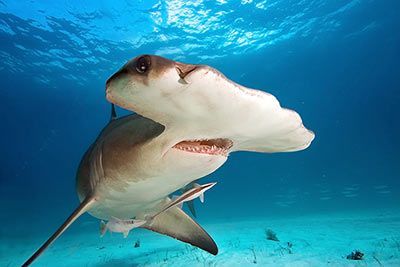
- Some of the most well-known sharks are the great white shark, reef shark, bull shark, tiger shark, hammerhead shark, whale shark, and megalodon.
- The most well-known rays are the Giant Oceanic Manta Ray, Southern Stingray, and Spotted Eagle Ray.
- Both sharks and rays are carnivores. They hunt for fish, small crustaceans, invertebrates, clams, crabs, and echinoderms.
- Sharks have a unique tooth system: when one tooth falls out, another one moves in to take its place, kind of like how a bullet is loaded into a revolver.
- Rays have flat bodies and large wing-like pectoral fins. Their mouths, nostrils, and gills are located on the underside of their bodies.
- Some rays have a venomous sting.
- The largest shark is the whale shark, which can grow up to 41.5 feet (12.65 meters) long and weigh as much as 47,000 pounds (21.5 tons).
- The smallest shark is the Dwarf lanternshark, measuring only 6.2 inches (16 cm) in length and weighing around 5.2 ounces (150 grams).
- The biggest ray is the Giant oceanic manta ray, reaching lengths of up to 23 feet (7 meters) and weighing up to 5,300 pounds (2.4 tons).
- The smallest ray is the lesser electric ray, which is only 18 inches (45 cm) long and 8 inches (20 cm) wide.
Species List
Hammerhead Shark
Written by Silke Menne.
Megalodon
Written by Silke Menne.
Porcupine Ray
Written by Silke Menne.
Whale Shark
Written by Silke Menne.