animalfunfacts.net - The Animal Encyclopedia for Kids

ADVERTISEMENT

Chicken

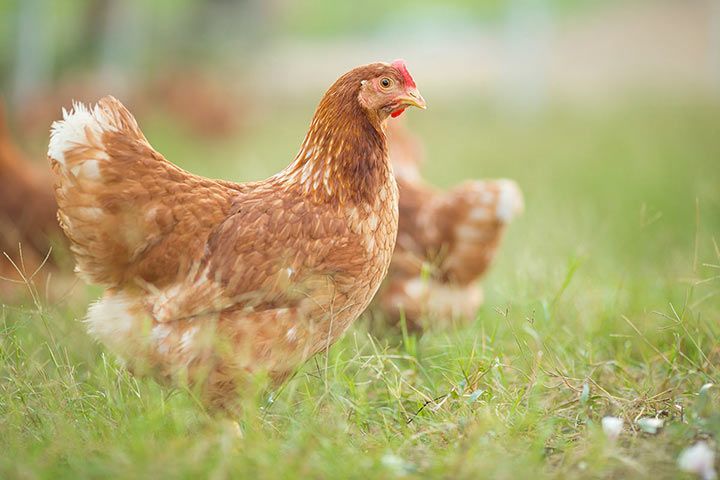
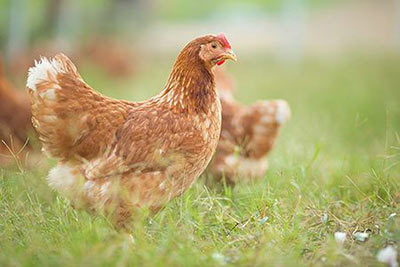
Hen Hen - Photo: Jakkrit Phomwong/Shutterstock

Chicken Facts

Size 15-24 in (40-60 cm)
Speed Up to 9 mph (while running)
Weight 9-12 lbs (4-5.5 kg)
Lifespan 5-10 years
Food Grains, seeds, grass, worms, snails, insects
Predators Crows, birds of prey, foxes, martens, raccoons
Habitat Worldwide
Order Galliformes
Family Phasianidae
Scientific name Gallus gallus domesticus
Characteristics Comb on its head; wattle under its beak

Main Characteristics

Domestic chickens are a subspecies of the red junglefowl. Their most distinctive features include the comb on their head and the wattles, especially prominent in roosters. Hens are known for their clucking, while roosters are recognized for their crowing. Chickens are quite intelligent and sensitive creatures, showing little difference from our cherished pets. However, they are often kept as livestock and suffer greatly due to poor living conditions.

Name

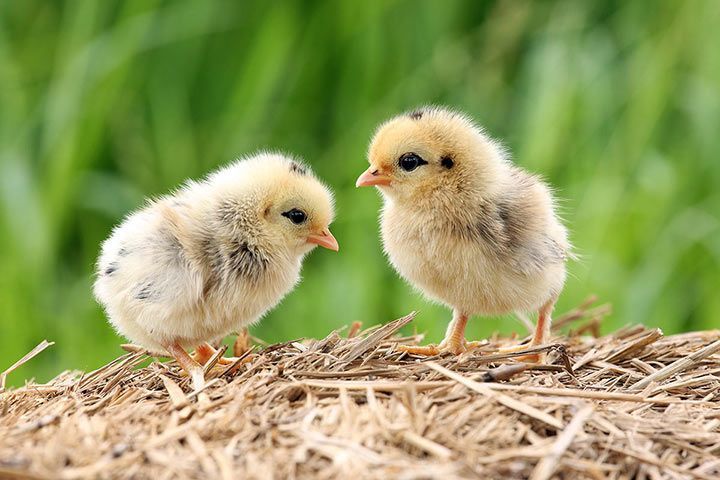
The male chicken is referred to as a rooster, while the female is called a hen. The young ones are known as chicks.


ADVERTISEMENT - ARTICLE CONTINUES BELOW

Distribution and Habitat

In the wild, chickens prefer the edges of forests and clearings. They feel comfortable and secure near trees, bushes, and hedges. They are fearful of open spaces, as they can easily fall prey to birds of prey there.

Hen Hen - Photo: bilanol/stock.adobe.com

Way of Life

Chickens are diurnal animals. In the wild, they form small groups of 10-15 individuals. They enjoy scratching the ground with their feet in search of food, such as seeds and insects, alongside their companions. In nature, they sleep in trees, where they are safer from birds of prey and martens. A group of chickens always includes at least one rooster.

Anatomy and Appearance

Size and Weight

The original chickens in Asia weigh 1.5-3.3 pounds (680-1.500 grams). Through breeding and fattening, chickens today weigh 9-12 pounds (4-5.5 kg) .

Comb and Wattle

The comb is a fleshy skin flap located on the head. Below the beak is another skin flap, known as the wattle. Both, the comb and the wattle serve the same  physical purpose: to cool down when it's hot. In warmer regions, chickens often have larger combs and wattles. In colder areas, they are smaller. The comb is particularly prominent in roosters. Their combs are larger than those of hens and usually have several points. Why? A large comb indicates that the rooster is healthy and strong. During mating season, it swells and stands upright, which is attractive to female chickens.


ADVERTISEMENT - ARTICLE CONTINUES BELOW

Rooster Wattle Rooster Wattle - Photo: jurra8/stock.adobe.com

Diet

Chickens are omnivores. They particularly enjoy grains, seeds, grass, worms, snails, and insects. Occasionally, they also eat lizards, small snakes, and mice.

Behavior

Perching on the Roost

Why do chickens perch on the roost? They feel safer there from ground predators. In the wild, they would sit on a branch in a tree.

Walking on Manure Piles

Why do chickens like manure piles? They can scratch around in them and peck for earthworms or other small creatures.


ADVERTISEMENT - ARTICLE CONTINUES BELOW

They Love Dust Baths

When it gets too hot for chickens, they enjoy taking a dust bath. They find a small depression in the sand and roll around in it. Additionally, the fine particles clean their feathers, removing not just dirt and grime but also parasites like fleas and mites. A dust bath can last up to half an hour.

A Variety of Sounds

Chickens have around 30 different sounds. They cluck with excitement. They make distress calls when they are in pain. They use calls to attract others and warning sounds. Roosters crow to defend their territory.

Crowing Rooster Crowing Rooster - Photo: Bob/stock.adobe.com

Abilities and Senses

Flying

Chickens are not capable of covering long distances. They only fly short distances, such as up into a tree to perch on a branch. Or over a fence.

Running

Chickens can run on the ground at speeds of up to 9 mph (15 km/h). While that may not seem fast, they can change direction very quickly. This ability helps them escape from predators.

Magnetic Sense

Chickens are the first site-faithful birds in which a magnetic sense has been discovered. This sense assists them in navigating on the ground.

Intelligence

Chickens are remarkably intelligent, sensitive, and affectionate creatures. They possess unique personalities and are self-aware. They also have a sense of time and contemplate the future. Chickens are considered to be as clever as primates. Here’s a brief list of facts about their intelligence:

Mathematical Abilities:

• Chickens can count and determine the number of objects in a group. They can do this as early as five days old.

• Chickens can track the trajectory of an object, even when it disappears from their line of sight. This requires significant cognitive effort to calculate flight paths.

• Chickens have an understanding of physics. They show more interest in objects that can actually be constructed than in those that cannot exist according to the laws of physics.

• Chickens understand what time is and have a sense of time intervals. In an experiment, they were supposed to peck at a specific point, but they only received a reward after six minutes. The chickens learned on their own that they didn’t need to peck the entire time and began doing so only when nearly six minutes had passed.

Social Intelligence:

• Chickens form communities with their peers and possess a complex hierarchy.

• Hens "communicate" with their unborn chicks.

• Hens exhibit various parenting styles, raising their chicks according to their unique personality traits.

• Chickens develop friendships.

• Chickens engage in play and act silly.

• Chickens pass their knowledge down to their offspring.

Logical Thinking and Self-Awareness

• Chickens take pleasure in solving puzzles. They grasp the connection between cause and effect.

• Chickens can distinguish over 100 of their peers – and they can remember them.

• Chickens comprehend that an object that has been hidden is not gone, but simply not visible. Children only begin to understand this around the age of one.

• They possess self-awareness and can consciously choose self-control. In humans, this ability develops around the age of four.

• Chickens dream and process their daily experiences during sleep. They experience REM phases – just like we do.

Life Expectancy

In the wild, chickens typically live between 5 to 10 years. The oldest chicken, according to Guinness World Records, lived to be 16 years old. However, laying hens only survive for about 1.5 years. A broiler chicken, on the other hand, is usually only alive for 40 days before being slaughtered.

Enemies and Threats

Chickens face natural predators such as crows, birds of prey, foxes, martens, and raccoons. Nevertheless, humans are the biggest threat to chickens.

Importance to the Ecosystem

Chickens play a crucial role in maintaining ecological balance by consuming various plant pests, including beetles and larvae. They act as a natural "insecticide", making them highly valued in flower and vegetable gardens.

Rooster and Hens Rooster and Hens - Photo: Bosko/Shutterstock

Chickens as Livestock

Factory Farming

There are over 25 billion chickens in the world, primarily raised for their eggs and meat. Unfortunately, 97% of these chickens are kept in inhumane conditions. The laying hens often suffer from diseases or injuries, leading to their premature death long before they reach their natural lifespan.

Laying Hens

In the past, chickens would lay 20-30 eggs a year. Nowadays, they are forced to produce 250-300 eggs annually, which is extremely exhausting for them. This excessive egg production also weakens their bones, as the eggshells draw calcium from their bodies, which is crucial for bone stability. As a result, 97% of laying hens suffer from broken breastbones, causing them significant pain. When these hens can no longer lay enough eggs or fall ill, they are slaughtered.

Broilers

The conditions for chickens raised for meat are equally dire in factory farming. They are crammed into tight spaces and must reach a weight of 3.3-12 pounds (1.5-5.5 kg) within just 28-40 days. During slaughter, these animals are not always killed humanely. Between 25 and 60 million chickens endure a painful death due to mistakes made during the process.

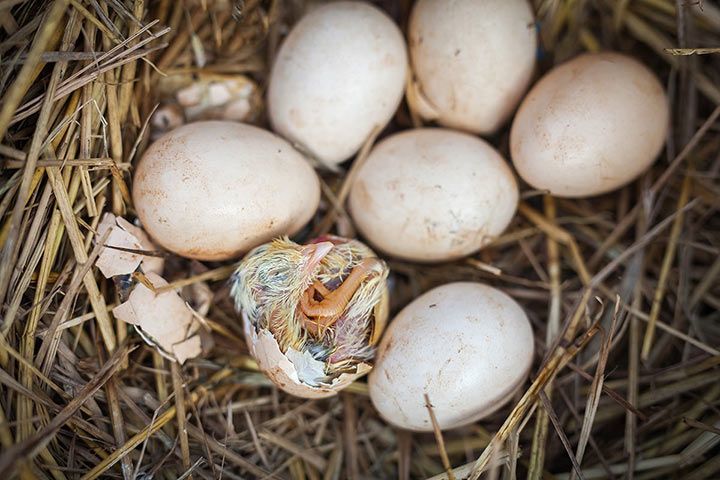
Chicken Eggs Photo: Lungkit/Shutterstock

Avoiding Chicken Suffering

How can we prevent the suffering of laying hens and broiler chickens?

Eggs

If you don't want to give up eggs, it's best to find a local farmer who treats their animals well. Generally, you should avoid eggs from supermarkets or processed products, as 97% come from factory farming. Even if the carton says 'free-range,' that is often not the reality.

Chicken Meat

The best way to avoid the suffering of broiler chickens is to stop eating them altogether. 97% of these animals have never seen daylight before being slaughtered. They are kept and killed under horrific conditions. There are delicious and healthy alternatives available, and cooking plant-based can be a lot of fun.

For more information, you can visit the children's page of the animal welfare organization PETA: https://www.petakids.com

Fledgling Photo: PCHT/Shutterstock

Fun Facts

Do Brown Hens Lay Brown Eggs?

At first glance, this seems logical, but it's actually a misconception. If that were true, then black and white chickens would lay black and white eggs as well. The color of the eggs is determined by the breed, not the feather color.

Animals in the Same Biome:


Galliformes Species Fact Sheets


ADVERTISEMENT


See all topics on animalfunfacts.net: