All About Salamanders, Newts and Olms
With their long tails, moist skin, and incredible superpower, salamanders are truly fascinating creatures capable of regenerating body parts!
What Are Salamanders?
Salamanders are amphibians. Unlike frogs, they possess long tails. They can thrive both on land and in water due to their moist skin, which allows them to breathe. However, be cautious! Their skin can also be toxic, as some species have poison glands and protect themselves with a toxic slime against predators, such as salamanders. Many salamanders have an astonishing ability: they can regenerate severed body parts like tails or legs.
Main Characteristics of Salamanders, Newts and Olms
- There are 600 species of salamanders and newts.
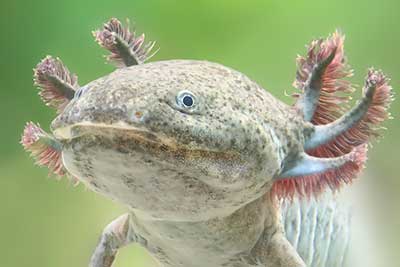
- The most well-known include the axolotl, dusky salamander, fire salamander, tiger salamander, giant salamander, pacific newt, easter newt, alpine newt, crested newt, smooth newt, and the olm.
- Most salamanders and newts are found in the Northern Hemisphere, with some also inhabiting the Southern Hemisphere.
- In Australia, there are no salamanders and newts.
- In Germany, both the fire salamander and the alpine salamander can be found.
- The most common newts in Germany include the Alpine crested newt, the alpine newt, the palmate newt, the smooth newt, and the crested newt.
- Salamanders and newts are carnivores. They primarily feed on insects, spiders, and small, invertebrate animals. Salamanders and newts have small teeth.
- Among all amphibians, the Siberian salamander can endure the lowest temperatures. It survives at -31 degrees Fahrenheit (-35 degrees Celsius).
- The giant palm salamander boasts the fastest tongue in the animal kingdom. It can extend it in just 7 milliseconds. That's 50 times quicker than a blink of the eye.
- The mushroom-tongued salamander is the smallest salamander. It measures only one inch (2.54 cm) in length, including its tail.
- The stickiest salamander is the northern slimy salamander. A fluid seeps from its skin. When it is attacked by a predator, this fluid sticks to their mouth, preventing them from being eaten.
- The western newt or Pacific newt is the most venomous salamander. Consuming just 0.00004 ounces (1 mg) of its poison can be fatal to a human.
- The largest salamander is the Chinese giant salamander. An animal named Karlo at the Prague Zoo measured 5 feet (1.58 meters) in length and weighed 77 pounds (35 kg).
- The Alpine salamander is considered the most cannibalistic animal in the world. The female lays up to 60 eggs. The first embryos that develop sufficiently end up eating their siblings. As a result, only a maximum of four young ones are born.
- The Alpine salamander also holds the record for the longest gestation period. It lasts for 37 to 38 months.
Salamander Family Tree
Top 3 Features of Salamanders
1. Long Tail
The long tail is one of the most distinctive features of salamanders. In water, it serves as a rudder. On land, it helps them escape from predators, as they can easily shed it if caught. Fortunately, it grows back! The tail also has another function: it stores fat and provides energy when they cannot find food for an extended period.
2. Moist Skin
Salamanders can breathe through two organs: their lungs and their thin, permeable skin. Pretty handy, right? Their skin is also very smooth and moist, allowing them to glide through water with minimal effort and protecting them from drying out on land.
3. Limbs Can Regenerate
Salamanders can lose arms, legs, and tails while fleeing or defending themselves. Unlike most other animals, their limbs can regenerate. They possess special cells that can transform into muscles, skin, bones, or nerves. It takes some time—depending on the species and size, it can range from a few weeks to several months.