animalfunfacts.net - The Animal Encyclopedia for Kids

ADVERTISEMENT

Top 15 Weirdest Animals in the World

#13 Giant Isopod (Bathynomus giganteus)

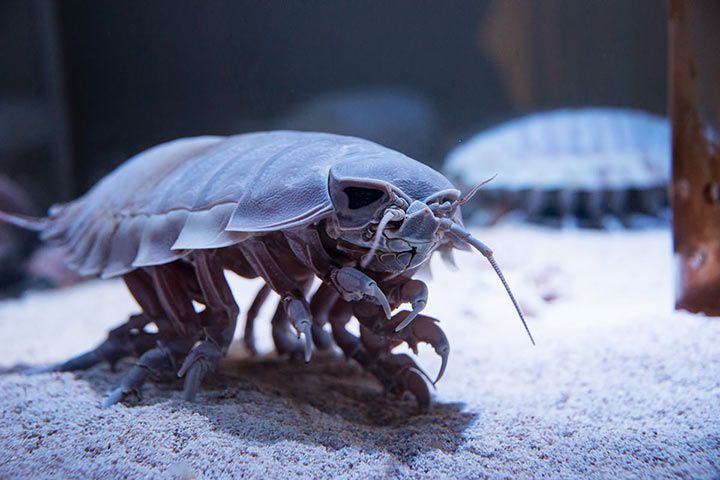
Giant Isopod - Photo: kikujungboy/Shutterstock

Facts

  • Class: Malacostracans
  • Order: Isopods
  • Family: Cirolanidae
  • Distribution: Atlantic, Pacific; caves, deep sea
  • Habitat: Cold seabed; at depths ranging from 500 to 6,500 feet (150 to 2,000 meters)

Giant Insect: The Armor of the Deep Sea

When you lift an old flower pot in the garden or a box in a damp basement, a few small gray pill bugs usually scurry away. They are completely harmless and only about one centimeter in size. However, if we dive into the pitch-black deep sea, we encounter a relative that can give some people quite a fright: the giant isopod (scientific name: Bathynomus giganteus) can grow up to 20 inches (50 cm) long and weigh over 4 pounds (2 kg)! That makes it as large as a small dog or cat.


ADVERTISEMENT - ARTICLE CONTINUES BELOW

Although they visually resemble giant insects, isopods surprisingly belong to the class of crustaceans. The body of the giant isopod is protected by an extremely hard shell made of chitin. Just like their small relatives on land, the giant isopod can roll itself into a nearly impenetrable, round ball when threatened.

Why Is this Animal so Unusually Large?

In biology, this phenomenon is referred to as deep-sea gigantism. Many invertebrates that inhabit the frigid depths of the ocean grow into true giants. Scientists are still investigating the reasons behind this. However, two main factors play a significant role: the extremely cold water slows down the animals' metabolism, allowing them to live much longer and have more time to grow. Additionally, their large size helps protect them from being crushed by the immense water pressure at such depths.

Giant isopods have two enormous, sturdy compound eyes made up of nearly 4,000 individual facets. Since it is pitch dark at the ocean floor, they primarily rely on their two long pairs of antennae when searching for food. With these, they can detect even the slightest vibrations and chemical traces in the water.

The Ocean Floor's Garbage Collectors: Eating Until They Burst

In the dark depths of the ocean, no plants grow. The giant isopod survives by consuming what falls from above. As scavengers, these creatures feast on sinking fish carcasses, dead squids, or even deceased whales. When such a banquet lands on the ocean floor, hundreds of giant isopods often gather to strip the carcass down to the bones.

However, since food is extremely scarce at this depth, the giant isopod has adapted to a life of famine. It gorges itself during a meal to the point where it can barely move afterward. The clever part? It can then survive for several years without any food! In a Japanese aquarium, one giant isopod even refused to eat for over five years before it passed away.


ADVERTISEMENT - ARTICLE CONTINUES BELOW

Next up: A floating bush in the ocean!

We leave the icy, dark ocean floor but remain in the cool waters. Along the coasts of Australia, there's a creature waiting for you that has perfected the art of camouflage. It doesn't resemble a fish but looks like a torn piece of seaweed drifting through the waves. Click ahead to meet the stunning leaf fish!


Sources:


ADVERTISEMENT - ARTICLE CONTINUES BELOW